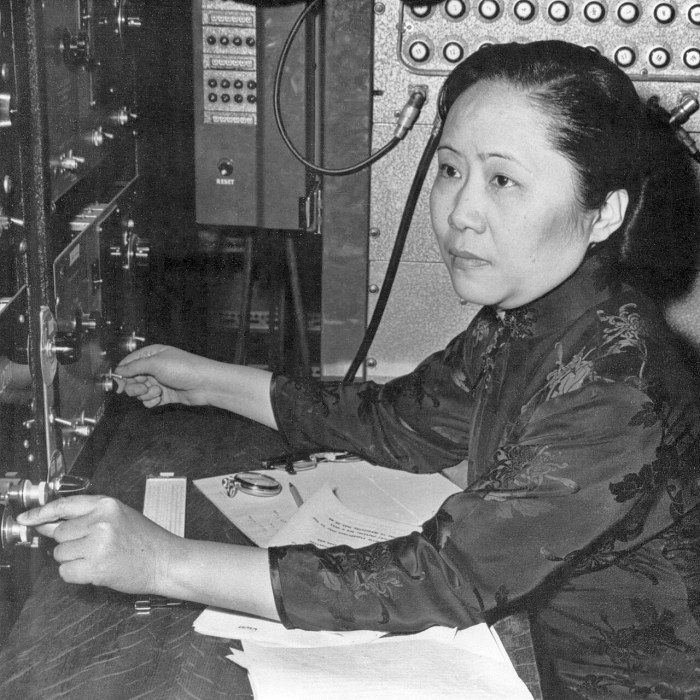
Chien-Shiung Wu
The experiment that overturned a law of physics was hers; the Nobel Prize went to the theorists
Chien-Shiung Wu was born in 1912 in a small town near Shanghai. Her father, an engineer, founded one of the first schools for girls in the region so that she and others could be educated. She excelled, studied physics at National Central University in Nanjing, and in 1936 sailed to the United States to do a doctorate at Berkeley, expecting to return. War and then revolution intervened. She never saw her parents again.
In the US she faced two obstacles at once, as a woman and as an Asian immigrant. Despite an outstanding PhD, no research university would appoint her. She taught at Smith College and Princeton before Columbia recruited her to the Manhattan Project, where she solved a problem that had stalled the plutonium reactors at Hanford.
Her reputation was for experiments of extraordinary care. In 1956 two theorists, Tsung-Dao Lee and Chen-Ning Yang, suggested that a supposedly fundamental symmetry of nature, that physical processes look the same in a mirror, might not hold for the weak nuclear force. Almost nobody thought it worth testing. Wu did. Cancelling a trip to China, she cooled radioactive cobalt to a fraction of a degree above absolute zero and showed that its electrons preferred one direction. The result stunned physicists.
Lee and Yang won the Nobel Prize in 1957. Wu did not. She became the first woman to lead the American Physical Society and received the inaugural Wolf Prize in Physics. She died in 1997, and her ashes were buried in the courtyard of the school her father founded.