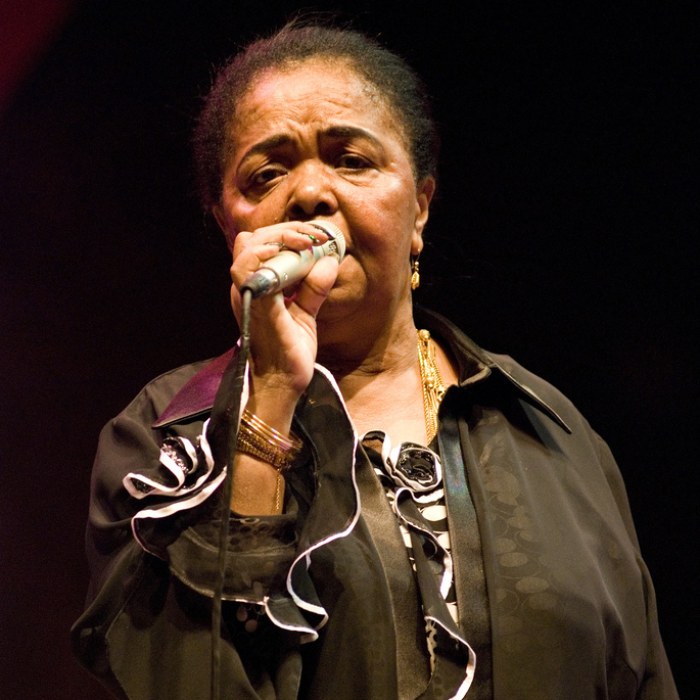
Cesária Évora
Gave up singing for ten years and was over fifty when the world finally heard the barefoot diva of Cape Verde
Cesária Évora was born in Mindelo, the port town of São Vicente in the Cape Verde islands, then a poor Portuguese colony. Her father, a musician, died when she was seven, and her mother, unable to feed her children, put her in an orphanage at ten. By sixteen she was singing in the bars and clubs along the harbour, mostly morna, the slow, mournful Cape Verdean songs of leaving and longing that had grown up with emigration and the sea.
She sang like that for twenty years, for whatever the sailors and bar owners paid, usually barefoot, which she later said was a gesture of solidarity with the poor women of the islands. After independence in 1975 the ships stopped calling and the bars closed. She stopped singing altogether for ten years, drank and looked after her children.
In 1985 a Cape Verdean women\'s organisation persuaded her to record in Lisbon. A French-Cape Verdean producer, José da Silva, then invited her to Paris, and her first album there in 1988 announced her as the barefoot diva. Miss Perfumado, in 1992, with the song Sodade, sold hundreds of thousands of copies across Europe. She was 51.
She spent the next two decades touring the world, still barefoot, still smoking on stage, and won a Grammy in 2004. After a series of strokes and heart problems she retired in September 2011 and died at home in Mindelo that December. Her face is now on Cape Verdean banknotes and the island\'s airport bears her name.