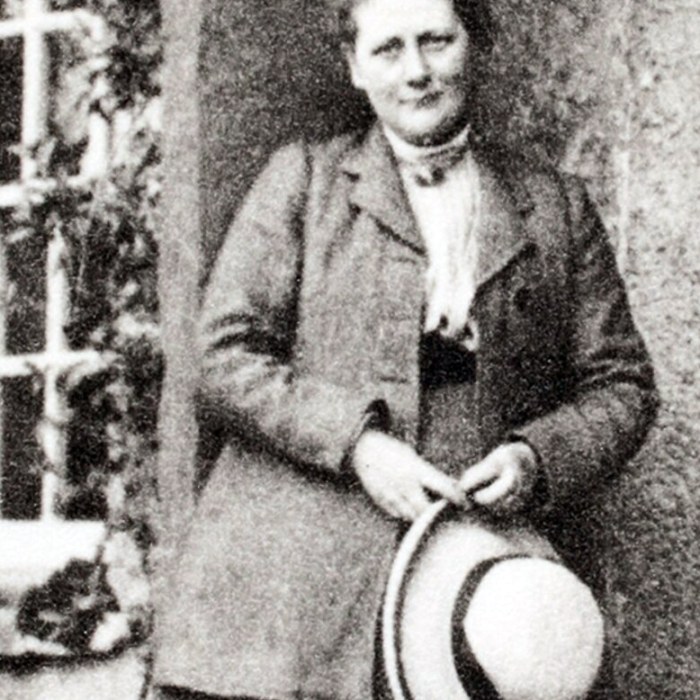
Beatrix Potter
Rejected by publishers, she printed Peter Rabbit herself and ended up saving a corner of the Lake District
Helen Beatrix Potter grew up in a wealthy London household where children were kept upstairs with governesses and rarely mixed with anyone their own age. She filled the quiet with animals, keeping rabbits, mice, a hedgehog and lizards in the schoolroom, drawing them obsessively and painting fungi with a precision that impressed working naturalists. In 1897 a paper of hers on spore germination was read to the Linnean Society by a man, because women were not allowed to attend.
Peter Rabbit began in 1893 as a letter to a sick child, Noel Moore, the son of her former governess. When she turned it into a book, at least six publishers declined it. So in 1901 she paid for 250 copies herself. Frederick Warne relented the following year on condition she added colour, and the little book sold in the tens of thousands.
Her editor, Norman Warne, proposed in 1905. Her parents objected to her marrying a tradesman; he died of leukaemia within a month of the engagement. Grieving, she used her royalties to buy Hill Top, a small farm in the Lake District, and began to spend as much time there as her family would allow.
In 1913, at 47, she married a local solicitor, William Heelis, and became a serious sheep farmer, breeding Herdwicks and buying up land to keep it from developers. When she died in 1943 she left over 4,000 acres and fifteen farms to the National Trust.