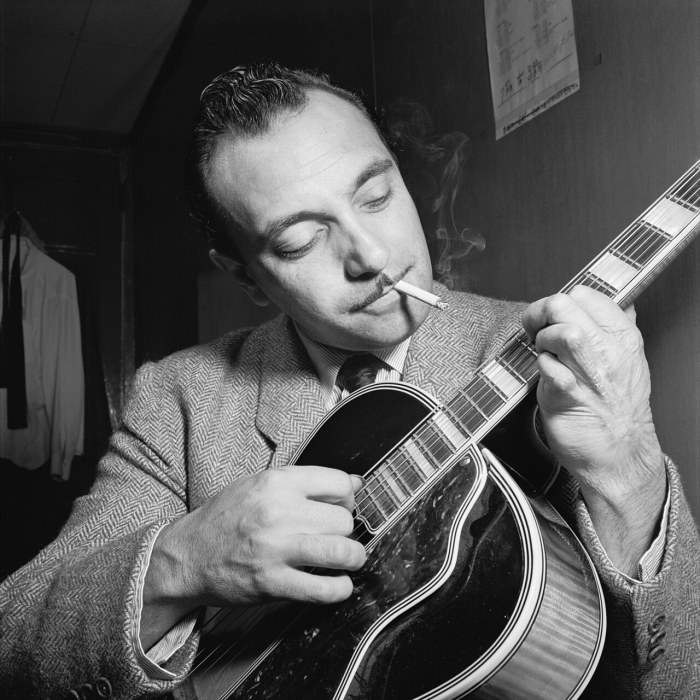
Django Reinhardt
Lost the use of two fingers in a caravan fire and reinvented the guitar with the ones he had left
Jean Reinhardt, known as Django, was born in a caravan near Liberchies in Belgium to a family of Manouche Romani travellers. He grew up in the encampments on the edge of Paris, never learned to read or write and was playing banjo and guitar in bars and dance halls by twelve. Before he was eighteen he was making records.
One night in November 1928 a candle fell on a pile of celluloid flowers his wife had made to sell. The caravan went up in seconds. Django was pulled out with severe burns down his right side and across his left hand. Doctors wanted to amputate the leg; he refused and eventually walked again with a cane. The ring and little fingers of his fretting hand were left permanently curled and useless.
He was given a guitar in hospital and, over the next year and a half, worked out a new way to play. He used two fingers for solos and dragged the damaged ones across the strings for chords, and the result was faster and more fluid than what he had done before.
In 1934, with the violinist Stephane Grappelli, he formed the Quintette du Hot Club de France, the first jazz group of international standing not from America. He survived the German occupation, when the Nazis were murdering Roma across Europe, toured the United States with Duke Ellington in 1946 and died of a brain haemorrhage in 1953, aged 43.