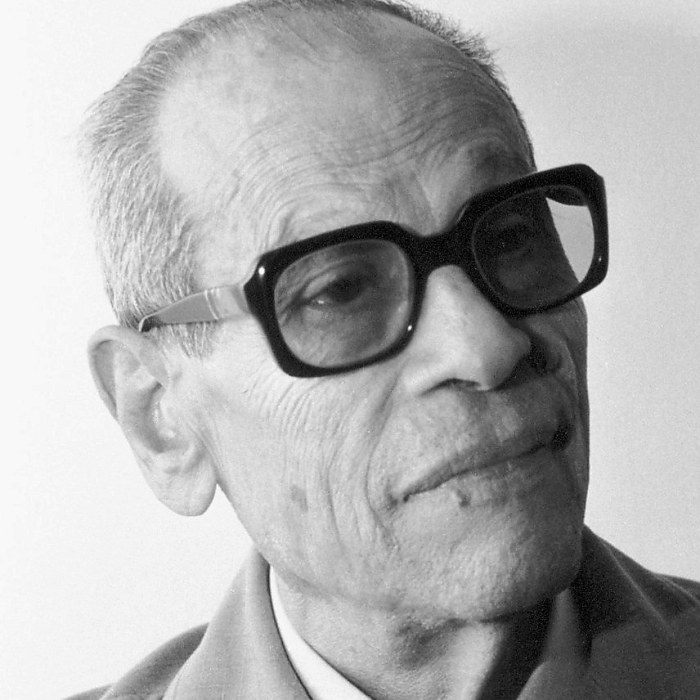
Naguib Mahfouz
A civil servant who wrote novels after work, was banned at home, won the Nobel and was stabbed at 82
Naguib Mahfouz was born in the old Gamaliya quarter of Cairo, the youngest of seven children of a minor civil servant, and grew up in the alleys and courtyards that became the setting for most of his fiction. He studied philosophy at Cairo University and, from 1934, spent thirty-seven years as a government employee, in the ministry of religious endowments, in film censorship and finally as an adviser at the ministry of culture. He wrote his novels before and after office hours, on a fixed schedule, every day.
Egyptian readers came to him slowly. The Cairo Trilogy, three novels following a merchant\'s family from the First World War to the Second, was published in 1956 and 1957 and made him the leading novelist in Arabic. His next book, Children of the Alley, an allegory of the prophets, was serialised in a newspaper in 1959 and then banned in Egypt for decades after religious objections. He shrugged and wrote the next one.
In 1988 he became the first writer in Arabic to win the Nobel Prize in Literature. He was too frail to travel to Stockholm and sent his daughters. In 1994, walking to a cafe near his home, he was stabbed in the neck by a young Islamist who had never read a word of his work. He survived, but the nerves in his right arm were damaged and he could write for only a few minutes a day. He dictated instead. He died in Cairo in 2006, aged 94.