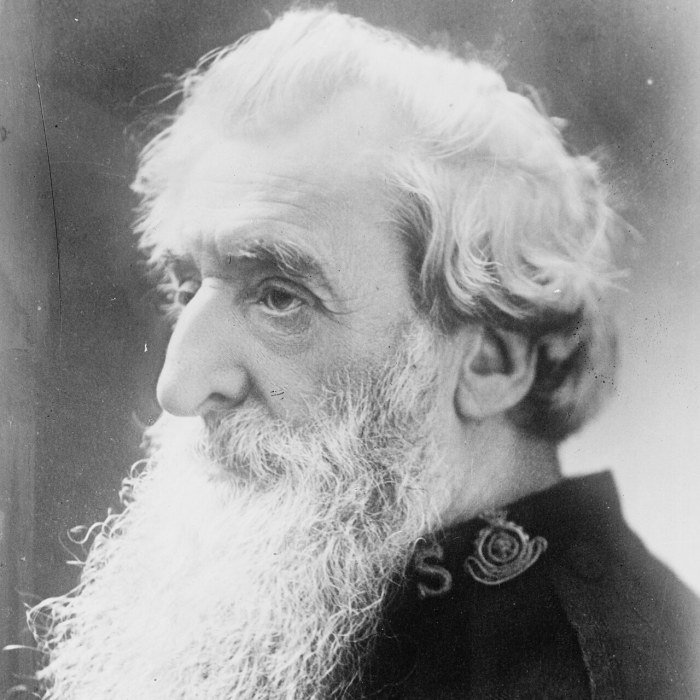
William Booth
A pawnbroker's apprentice who took a mission into the East End and made an army of it
William Booth grew up in Nottingham in a family sliding into poverty. He was apprenticed to a pawnbroker at thirteen, saw the desperation of the customers, and became a Methodist preacher in his teens. His refusal to sit still in a settled pulpit meant a series of quarrels with church authorities, and by 1861 he and his wife Catherine, a formidable preacher in her own right, were travelling evangelists with no fixed income and a growing family.
In 1865 he was invited to preach in a tent outside a pub in Whitechapel and decided the East End was where he belonged. The Christian Mission he founded held meetings in music halls and dance rooms and offered soup with the sermon. In 1878, while correcting a printer's proof, he changed the word "volunteer" to "salvation", and the Salvation Army was born, with uniforms, brass bands, ranks and Booth as General.
It was violently unpopular. Publicans organised a "Skeleton Army" that pelted marches with stones and dead rats, and hundreds of Salvationists were jailed for obstructing the streets. Booth carried on. In 1890 he published In Darkest England and the Way Out, a plan for shelters, farm colonies, labour bureaus and help for released prisoners and prostitutes, and the Army's practical work grew to match its preaching. It even ran a match factory paying decent wages, to shame manufacturers whose workers suffered from phosphorus poisoning.
He was autocratic, and several of his children broke with him. But by the time he died in 1912, tens of thousands filed past his coffin.