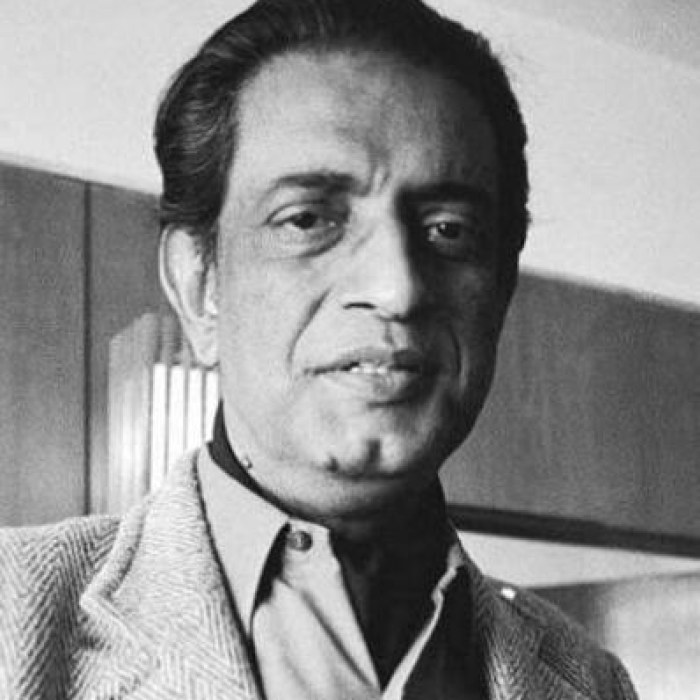
Satyajit Ray
Pawned his wife’s jewellery to keep shooting a film that took three years and launched Indian cinema abroad
Satyajit Ray was born in Calcutta into a family of writers and printers. His father, a celebrated poet of nonsense verse, died when he was two, and his mother raised him on a small income among relatives. He studied economics, then, at his mother's insistence, spent two years at Rabindranath Tagore's rural university at Santiniketan, where he learned to look at Indian art and landscape.
He worked as a graphic designer for a British advertising agency in Calcutta, designing book covers and typefaces. One of the books he illustrated was a novel about a poor family in a Bengali village, Pather Panchali. In 1949 he met the French director Jean Renoir, who was filming in Bengal, and in London the following year he saw Bicycle Thieves and came out of the cinema determined to make a film.
He had no money, no training and a cast of mostly non-professionals. Shooting began in 1952 with borrowed cameras and stopped whenever funds ran out, which was often. He sold his insurance policies and pawned his wife's jewellery. The child actors grew older between sessions. Eventually the West Bengal government put up the money, reportedly as a road-improvement project.
Pather Panchali was released in 1955 and won a prize at Cannes the next year. Ray went on to make more than thirty films, writing his own scripts and music, and received an honorary Academy Award in 1992 from his hospital bed, weeks before his death.