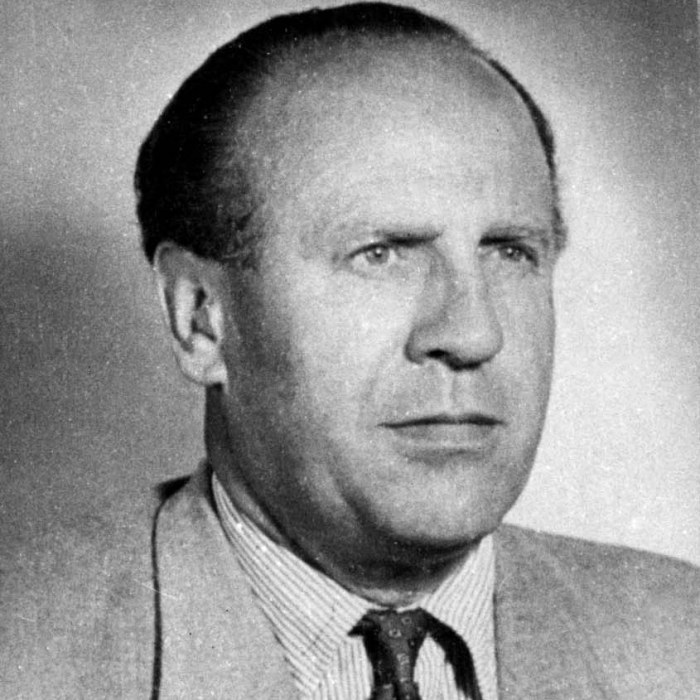
Oskar Schindler
A Nazi profiteer who spent his fortune bribing officials to keep 1,200 Jews alive
Oskar Schindler was born into a German-speaking family in Moravia and made a poor start in life: a failed marriage of sorts, debts, drink and, from the mid-1930s, spying for German military intelligence against Czechoslovakia, for which he was briefly jailed. He joined the Nazi Party in 1939 and followed the German army into Kraków that autumn looking for opportunities.
He found one in a bankrupt enamelware factory, which he took over with Jewish capital and Jewish workers because they were cheap. He was good at what he did: charm, black-market goods, cognac and cigars kept the SS and Wehrmacht contracts flowing. At some point, watching the liquidation of the Kraków ghetto in 1943 and the sadism of Amon Göth, commandant of the Płaszów camp, the profiteer became something else. He arranged for his workers to be housed in a sub-camp at the factory, away from Göth, and spent his money on food and medicine for them.
In late 1944, with the camp being emptied to Auschwitz, he obtained permission to move his factory to Brünnlitz in Moravia and drew up a list of about 1,200 workers to go with it. When a train of his women workers was diverted to Auschwitz he bribed their release. The Brünnlitz factory produced almost nothing usable. He fled at the war's end, penniless.
His later life was a series of failures: a farm in Argentina, a cement works in Germany, bankruptcy, dependence on gifts from those he had saved. Israel honoured him in 1963. He died in 1974 and was buried in Jerusalem.