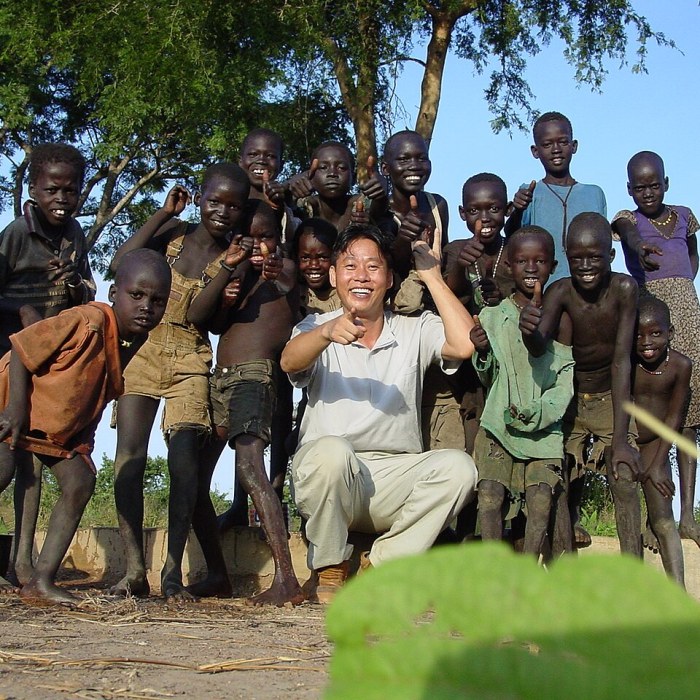
Lee Tae-seok
A Korean doctor turned priest who built a hospital, a school and a brass band in South Sudan
Lee Tae-seok was born in Busan in 1962, the ninth of ten children. His father died when he was nine and his mother kept the family fed by sewing. He was a good student and made it into medical school at Inje University. He qualified, did his military service as a doctor, and then, to his family's dismay, announced that he wanted to become a priest.
He joined the Salesians, whose work is with poor young people, studied in Rome, and was ordained in 2001. He had already visited southern Sudan, then near the end of a long civil war, and asked to be sent to Tonj, a town with no electricity, no doctor and no school worth the name.
Over the next eight years he built a clinic that grew into a hospital, treating three hundred patients a day and going out by jeep to a village of leprosy patients whose feet he measured for shoes. He built a school with his own hands and taught in it. He also formed a brass band, teaching children who had grown up with the sound of guns to play trumpets and clarinets, and it marched in parades across the region. He was known as Father Jolly.
On a visit to Korea in 2008 he was diagnosed with colon cancer. He died in January 2010, aged forty-seven. A documentary about his life, Don't Cry for Me Sudan, was watched by millions in Korea, and several of his students went on to study medicine.