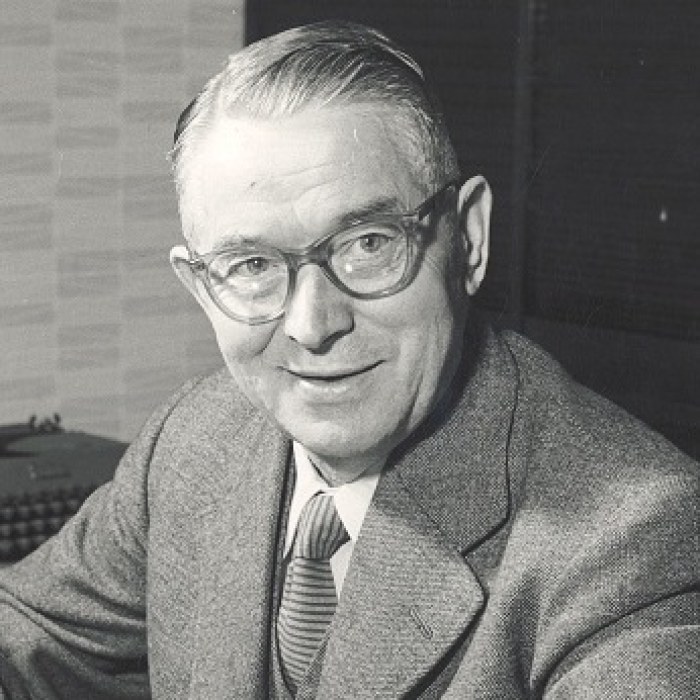
Ole Kirk Christiansen
A village carpenter whose workshop burned down twice and who made toys because nobody was buying houses
Ole Kirk Christiansen was born in 1891 into a poor family in Filskov, Jutland, the tenth of thirteen children, and was sent out as a shepherd boy at six. He trained as a carpenter, worked in Germany and Norway, and in 1916 bought a joinery in the village of Billund, building houses and furniture for local farmers.
In 1924 two of his young sons set fire to a pile of wood shavings and the workshop and family home burned down. He rebuilt on a bigger scale, which left him with debts just as the Depression arrived and the farmers stopped building. In 1932 his wife Kristine died, leaving him with four boys. That year, with no orders, he began making things people might still pay a few coins for: stepladders, ironing boards, and small wooden toys such as pull-along ducks. In 1934 he ran a competition among his staff for a name and chose his own entry, Lego, from "leg godt", play well.
The toys sold slowly, then steadily. He carved a sign for the workshop reading "Det bedste er ikke for godt", only the best is good enough, after finding that his son Godtfred had saved money by giving the ducks two coats of varnish instead of three, and sent him to the station to fetch the boxes back. In 1942 the factory burned down again.
In 1947 he bought Denmark's first plastic injection-moulding machine, an extravagance most of his family thought foolish. The interlocking bricks it produced from 1949 sold poorly at first. He died in 1958, the year the modern brick design was patented, and his son and grandson built the rest.