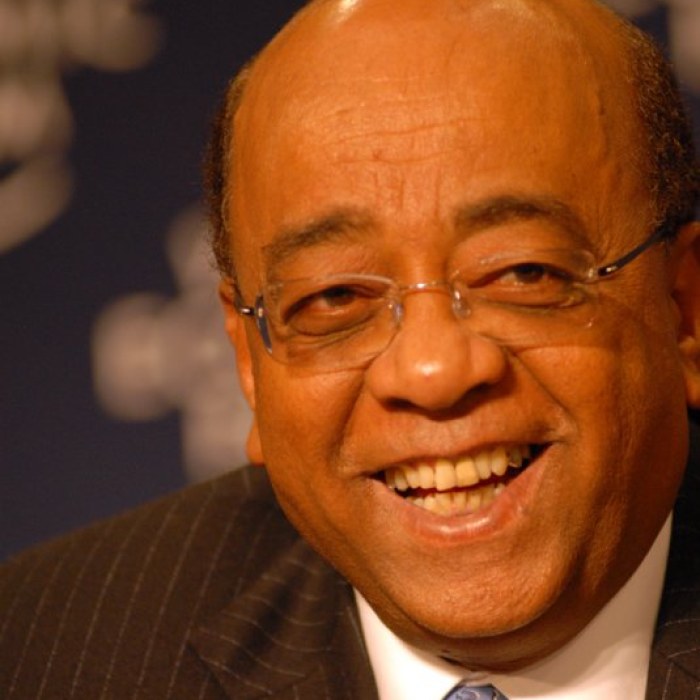
Mo Ibrahim
Built mobile networks across Africa without paying a bribe, then funded a prize for honest leaders
Mohamed Ibrahim was born in 1946 in northern Sudan, to a Nubian family; his father was a clerk with a cotton company. He studied electrical engineering in Alexandria, worked for Sudan's telephone service, and came to Britain in 1974 for a master's at Bradford and a PhD at Birmingham on mobile communications, a field that barely existed.
British Telecom hired him as technical director of its new Cellnet service in 1983. He grew impatient with the bureaucracy and in 1989 left to set up MSI, a consultancy that designed mobile networks, running it from his home with his wife and a handful of staff. It became a large firm, and in 1998 he spun off a company to build and run networks in Africa, where the big operators would not go. He named it Celtel.
Bankers told him that no one could do business on the continent without bribery, and that the risks were unmanageable. He decided that any payment over 30,000 dollars had to be approved by the board, and that no bribe would be paid at all. Networks were built in the Democratic Republic of Congo during its war, and in Sierra Leone, Uganda, Zambia and Malawi. The phones, it turned out, were what people wanted most; by 2005 Celtel had millions of subscribers in over a dozen countries and was sold to a Kuwaiti company for 3.4 billion dollars.
In 2006 he set up the Mo Ibrahim Foundation, which publishes an annual index of governance for every African country and awards a five-million-dollar prize to former heads of state who ruled well and left office when they should. It is often not awarded, which he says is the point.