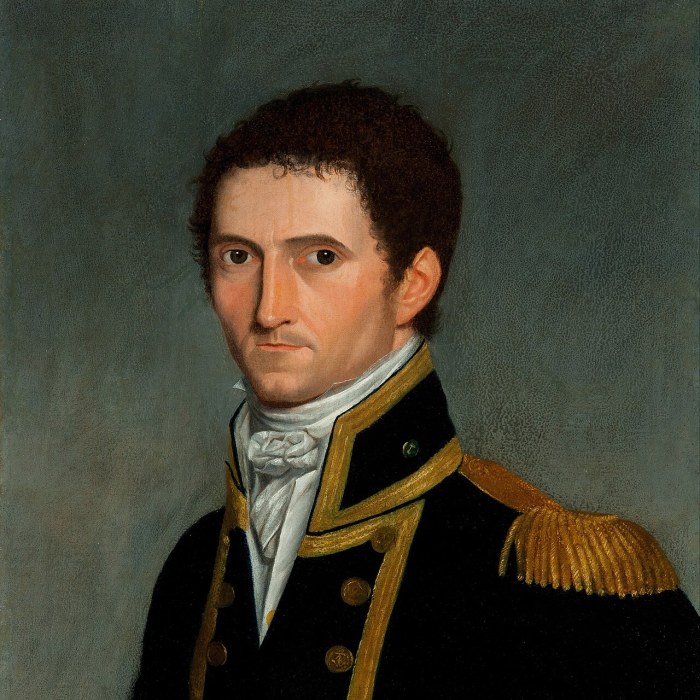
Matthew Flinders
Charted the coast of Australia, was imprisoned for six years on the way home, and named the continent
Matthew Flinders was born in the Lincolnshire fens and, against his father's wishes, joined the Royal Navy at fifteen after reading Robinson Crusoe. He sailed with Bligh on his second breadfruit voyage and reached Sydney in 1795, where he and the ship's surgeon George Bass explored the coast in a boat eight feet long they called Tom Thumb. Together they proved Tasmania was an island.
In 1801 he was given command of the Investigator to chart the whole coast of the southern continent. Among the crew was Bungaree, an Aboriginal man from the Sydney area, who acted as intermediary with coastal peoples along the way. Flinders surveyed with obsessive care, but the ship was so rotten that by 1803 it could barely float and he abandoned the last stretch.
Sailing home in a small schooner, he put in at Mauritius for repairs, not knowing that Britain and France were at war again. The French governor, suspicious of his passport and offended by his manner, detained him. He stayed for more than six years, writing up his charts, corresponding with scientists and pining for the wife he had left days after their wedding. He was released in 1810 with his health broken.
He spent his last years in London preparing A Voyage to Terra Australis, in which he argued for the name Australia. The book was delivered to him on 18 July 1814, the day before he died, aged forty. His grave, lost under Euston station, was found in 2019 and he was reburied in his home village in 2024.