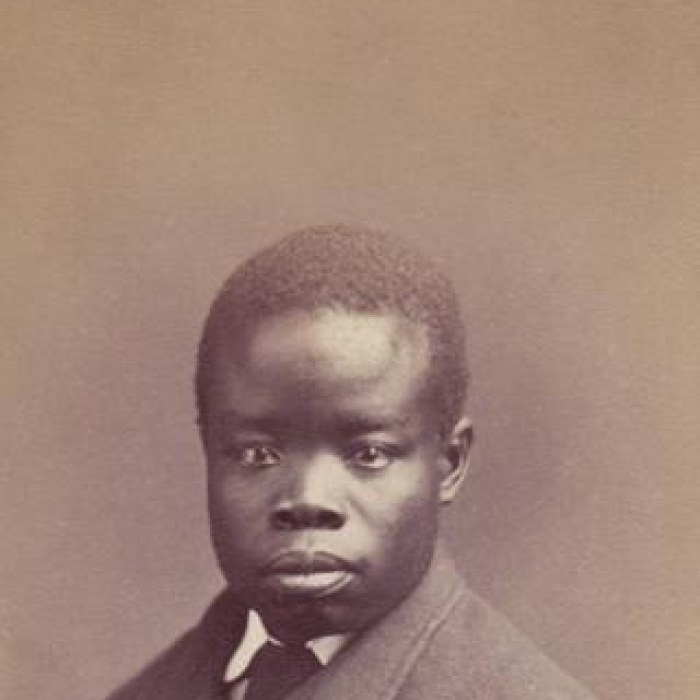
Jacob Wainwright
Freed from a slave ship as a boy, he helped carry his employer's body a thousand miles home
Jacob Wainwright was captured as a child in East Africa and put aboard a slave ship, which a British anti-slavery patrol intercepted before it completed its voyage. Freed captives from these interceptions were often taken to Bombay and placed in mission schools rather than simply released with nowhere to go, and Wainwright was educated there, learning English and taking a Christian name.
In 1872 he joined a relief expedition sent to resupply David Livingstone in central Africa, arriving not long before Livingstone's death from illness and exhaustion in 1873. Wainwright was among the small group of Livingstone's African companions, led by Chuma and Susi, who made the extraordinary decision to preserve the explorer's body rather than bury it locally, so that it could be identified and returned to Britain. Wainwright kept a written journal of the thousand-mile journey to the coast, one of the few first-hand accounts of the trek from any of its African participants.
He travelled on to Britain and stood among the pallbearers at Livingstone's funeral in Westminster Abbey in 1874, a rare moment of an African witness being included in a ceremony that otherwise treated Livingstone's death as a purely British story. He later returned to East Africa and worked for a time in missionary and colonial administration, though little detail survives of his later life or the date of his death.