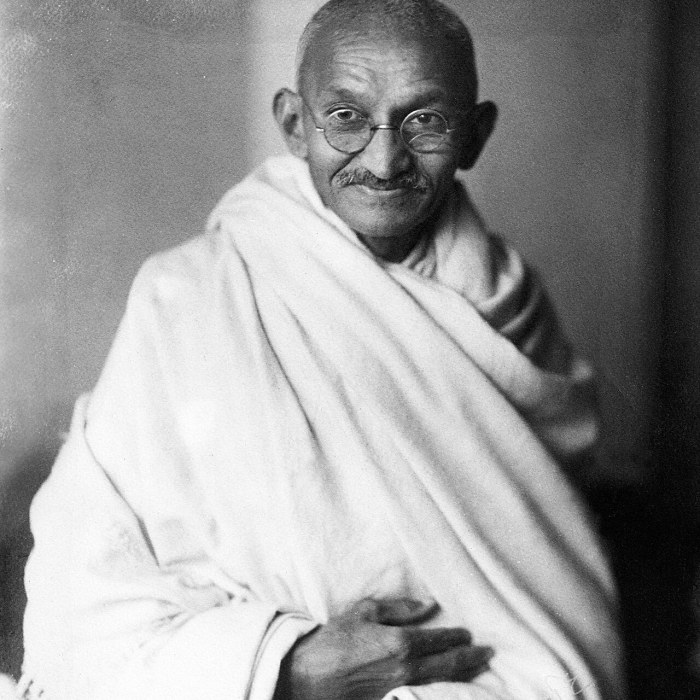
Mahatma Gandhi
Led India to independence with marches, fasts and a refusal to hit back
Mohandas Gandhi was born in Porbandar in 1869, married at 13, and went to London to study law at 18, where he was so nervous that he could barely speak in court. In 1893 he took a job in South Africa, and within weeks was thrown off a train at Pietermaritzburg for refusing to leave a first-class carriage. He stayed for 21 years, organising the Indian community against discriminatory laws and working out the method he called satyagraha, which relied on accepting punishment without striking back. His concern in those years was for Indians, and he wrote about Black Africans in terms that are hard to read today.
He returned to India in 1915 and within a few years led the Congress movement. He called off his first mass campaign in 1922 after protesters burned a police station with 22 officers inside, believing the country was not ready. In 1930 he walked 240 miles to the sea to make salt in defiance of the British monopoly, and tens of thousands followed him to jail. He was imprisoned repeatedly, and fasted almost to death to end violence between Hindus and Muslims.
He clashed bitterly with B. R. Ambedkar over the rights of the untouchables, and his treatment of his own family, and the "experiments" in celibacy of his last years, have drawn lasting criticism.
India became independent in August 1947 amid the bloodshed of partition, which he had opposed. On 30 January 1948 he was shot dead in Delhi by a Hindu nationalist.