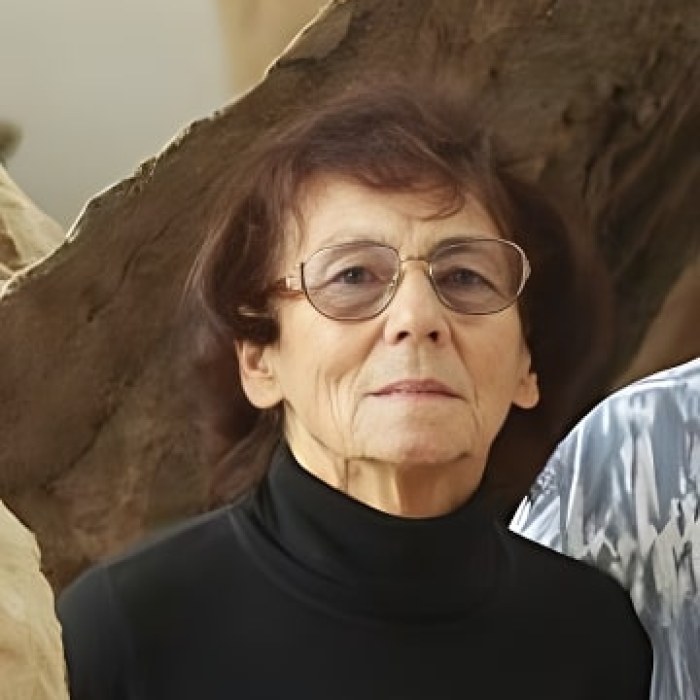
Magdalena Abakanowicz
Hid her aristocratic birth to get into art school and wove sculptures the size of rooms in a tiny flat
Magdalena Abakanowicz was born on a country estate outside Warsaw to a family that traced its descent from Tatar nobility. She was nine when the war began and thirteen when drunken soldiers broke into the house one night and shot her mother, who lost an arm. The family fled to Warsaw as the Uprising began, and the girl worked as a nurse\'s aide in a makeshift hospital.
After the war, aristocratic origins were a bar to almost everything, so she described herself as the daughter of a clerk and got into the Academy of Fine Arts. Socialist realism was the only permitted style. She studied textiles because weaving was considered harmless craft, and after graduating in 1954 worked in a single cramped room, with a husband and a bed, weaving pieces so large she could only see them properly once they hung in a gallery.
In the 1960s those pieces, dyed sisal and rope woven into vast, sagging organic forms that hung from ceilings, won a gold medal at the São Paulo Biennial and were named Abakans after her. Critics could not decide if they were tapestry or sculpture. She then turned to figures: rows of headless, hollow human backs made of burlap stiffened with resin, crowds of them, as anonymous as the queues and parades she had grown up among.
She taught in Poznań for a quarter of a century, filled a Chicago park with 106 iron figures in 2006, and died in Warsaw in 2017.