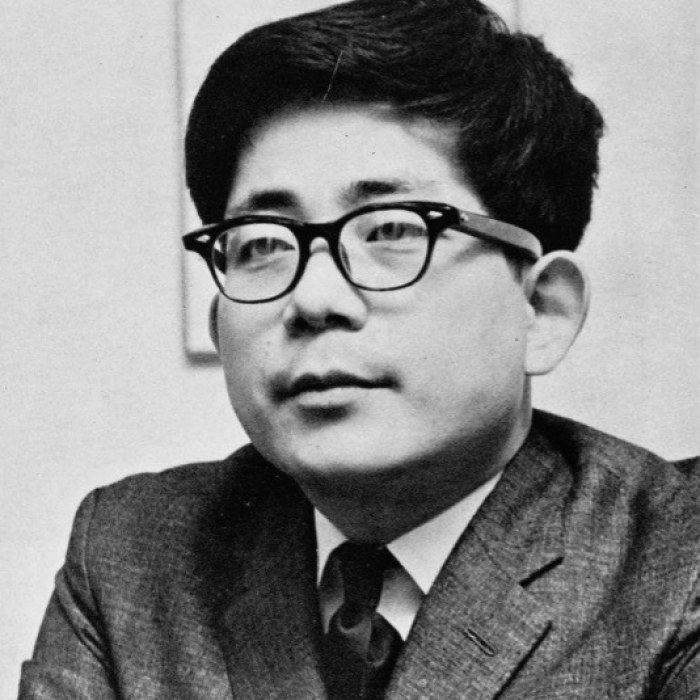
Kenzaburō Ōe
Told his brain-damaged newborn son would be better off dead, he chose otherwise and it remade his writing
Kenzaburō Ōe grew up in a forest village on the island of Shikoku, one of seven children. His father died in 1944 and, the following year, the boy heard the Emperor announce the surrender on the radio in an ordinary human voice, which he later described as the moment his world came apart. He went to Tokyo to study French literature, and at 23 won the Akutagawa Prize, Japan\'s most important award for new writers, for a story about a captured black American airman in a village like his own.
In 1963 his first son, Hikari, was born with a brain hernia. Doctors said that even with surgery he would be severely disabled and suggested the parents let him die. Ōe and his wife chose surgery. That same summer he went to Hiroshima to report on the survivors of the bomb and their doctors, and came back with a book, Hiroshima Notes, and a new sense of what endurance meant.
The novel that followed, A Personal Matter, is about a father who wants to abandon his damaged child and cannot. Hikari, who barely spoke, turned out to have an extraordinary ear and became a published composer, and his father wrote of him again and again. Ōe won the Nobel Prize in 1994 and immediately refused Japan\'s Order of Culture because it came from the Emperor. He campaigned against nuclear power after Fukushima and died in 2023, aged 88.