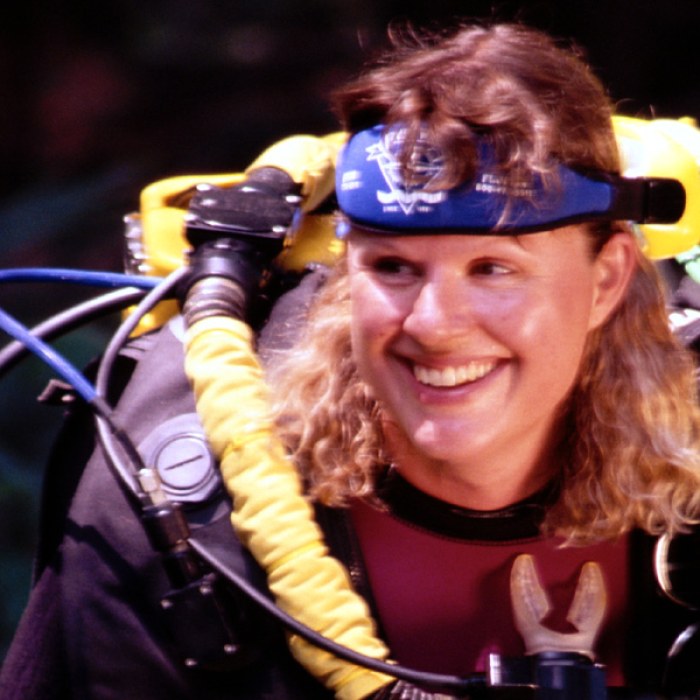
Jill Heinerth
Dives into flooded caves and icebergs most people would not enter with a rope tied to their waist
Jill Heinerth left a career in graphic design in her twenties to pursue technical cave diving, a discipline that involves navigating flooded, pitch-dark cave systems where a diver's only way out is often the same narrow, silt-filled passage they swam in through, with no possibility of a direct ascent to the surface if something goes wrong. She trained rigorously in the safety protocols the sport had only recently developed, in no small part because so many earlier cave divers had died learning them the hard way.
Her career has taken her into some of the most technically demanding underwater environments in the world, including extensive mapping of Florida and Bahamian cave systems that supply drinking water to millions of people, work that combines exploration with genuine environmental research. In 2000 she led the first team to dive inside an iceberg, in Antarctic waters, entering ice caves that could shift or collapse without warning, work she has described candidly as sitting right at the edge of what is survivable.
She has had multiple near-fatal incidents over her career, including a cave collapse and equipment failures deep inside cave systems where a single mistake compounds quickly, and she speaks openly about these close calls rather than only the successful dives, arguing that honesty about fear and error is what keeps the sport's newer divers alive.
She became the first Explorer-in-Residence of the Royal Canadian Geographical Society and continues to dive, film and speak about underwater caves, work she treats as inseparable from advocating for the fragile water systems those caves are often part of.