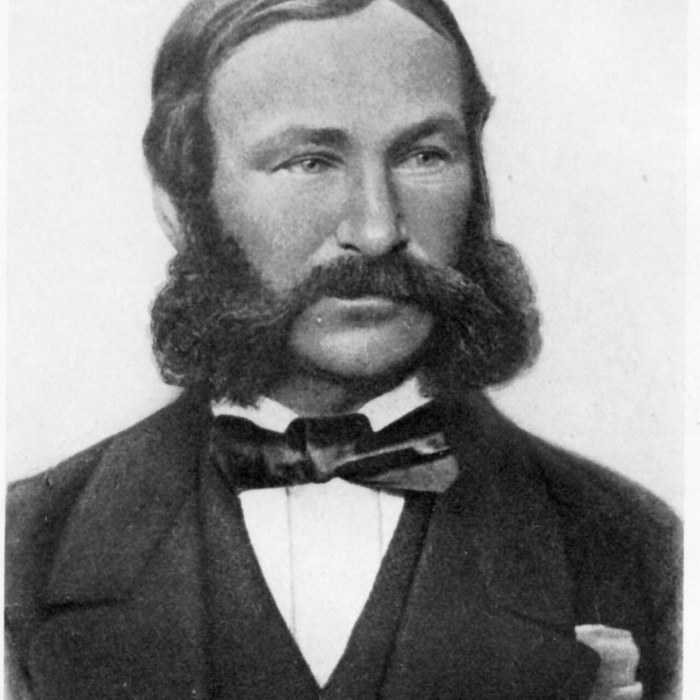
Heinrich Barth
Crossed the Sahara for five years, alone after his companions died, and mapped half a continent
Heinrich Barth trained as a classical scholar in Berlin and had already travelled extensively around the Mediterranean before joining a British government mission in 1850 led by James Richardson, intended to open trade routes across the Sahara and gather geographical and scientific information about Central Africa. Barth brought serious linguistic training to the expedition, determined to record accurately rather than simply pass through.
Within the first year, Richardson died of illness in the desert, followed soon after by the mission's other scientific member, Adolf Overweg. Rather than turn back, Barth continued largely alone for the following four years, travelling an enormous circuit through the Sahara and the Sahel, into the Sokoto Caliphate, Bornu, and as far as Timbuktu, where he was for a time held under effective house arrest by suspicious local authorities before being allowed to leave.
He learned Arabic, Hausa and Kanuri well enough to work directly with local scholars and rulers rather than through intermediaries, and used that access to collect oral histories, chronicles and geographic detail with a rigour few European travellers in the region matched, correcting numerous earlier European misconceptions about the interior of Africa along the way.
He returned to Europe in 1855 after five years away, most of them alone, and published his findings as the five-volume Travels and Discoveries in North and Central Africa, a work still consulted by historians of the region. Recognition in his own country was muted during his lifetime; he died in Berlin in 1865, still relatively young, having mapped more of West and Central Africa than any European before him.