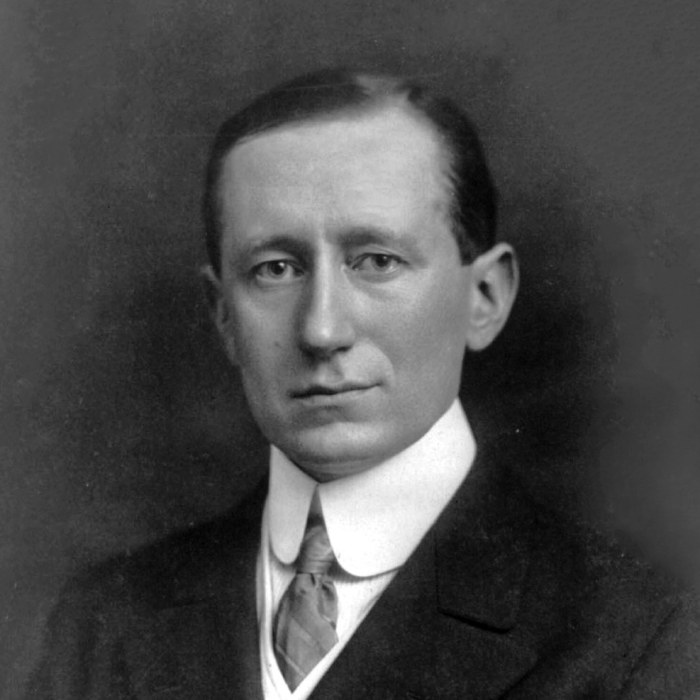
Guglielmo Marconi
Turned down by his own government, he took his radio to Britain and sent a signal across the Atlantic
Guglielmo Marconi was born in Bologna to an Italian landowner and an Irish mother from the Jameson whiskey family. He was educated by tutors and failed the entrance exam for the University of Bologna. In 1894, having read about Heinrich Hertz's experiments with electromagnetic waves, he began building equipment in the attic of the family villa to see whether the waves could carry messages.
Within a year he could ring a bell across the room, then send a signal over a hill more than a mile away. He wrote to the Italian Ministry of Posts offering the invention and received no reply. So in 1896, aged 21, he sailed with his mother to London, where her family connections got him a meeting with the chief engineer of the Post Office. He filed the first patent for wireless telegraphy that year.
He was as much promoter as inventor, staging demonstrations across the Bristol Channel, across the English Channel and for the yacht races that the newspapers loved. Physicists said radio waves could not follow the curve of the earth. On 12 December 1901, on a hill in Newfoundland, he reported hearing the three dots of the letter S sent from Cornwall. Sceptics have argued about it ever since, but two-way transatlantic service followed within a few years.
When the Titanic sank in 1912, the ships that came to rescue survivors were called by Marconi operators. He shared the Nobel Prize in Physics in 1909.