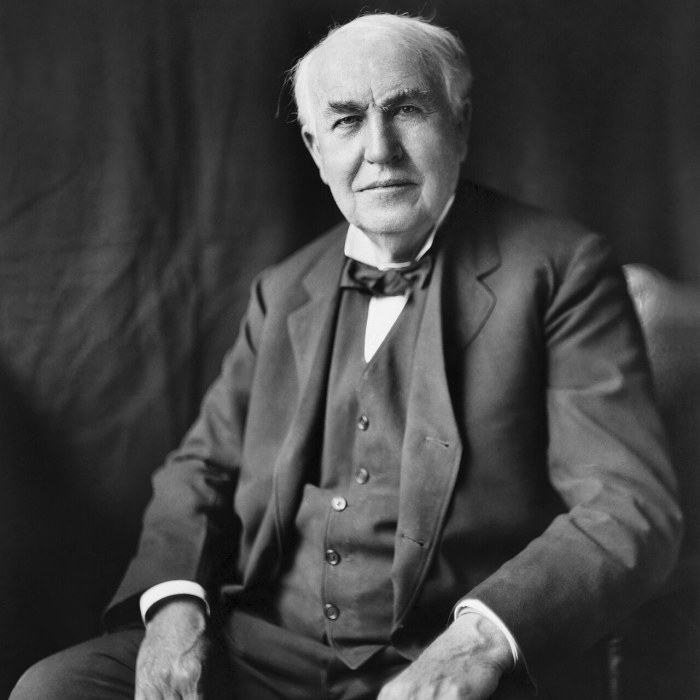
Thomas Edison
Three months of schooling, nearly deaf, and more than a thousand patents
Thomas Edison lasted about three months at school in Port Huron, Michigan, before a teacher called him addled and his mother took him home to teach him herself. By 12 he was selling newspapers and sweets on the train to Detroit, and setting up a chemistry laboratory in the baggage car. He had lost most of his hearing by his early teens, which he later said helped him concentrate.
He learned telegraphy and drifted between jobs as an operator, fiddling with equipment and getting sacked. His first patent, a vote-recording machine for legislatures, was a commercial failure because politicians did not want to vote faster. He decided to invent only things people would buy.
In 1876 he set up a laboratory at Menlo Park, New Jersey, the first place organised to produce inventions on a schedule. The phonograph, which came out of it in 1877, made him famous. The electric light took longer: two years testing thousands of filament materials before a carbonised thread glowed for over 13 hours in October 1879. Then he had to invent the generators, meters, fuses and wiring to go with it, and in 1882 opened the first power station on Pearl Street in New York.
He was a hard, sometimes ruthless boss, backed the wrong side in the fight over alternating current, and lost a fortune on an ore-crushing scheme. He held 1,093 patents when he died at 84.