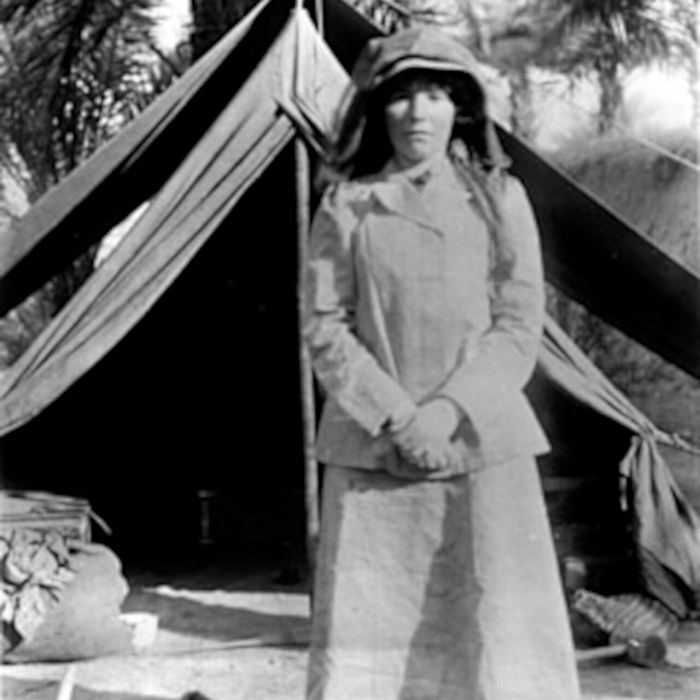
Gertrude Bell
Mapped Arabia for the British Empire, then helped draw the borders of a country still living with them
Gertrude Bell was one of the first women to earn a first-class degree in history from Oxford, at a time when women could sit the exams but not receive the actual degree. Restless in England, she travelled repeatedly through Ottoman Syria, Mesopotamia and Arabia from the 1890s onward, learning Arabic and Persian, climbing in the Alps, and publishing accounts of desert travel and archaeological sites that established her reputation as one of the most knowledgeable Western travellers in the region.
Her journeys were rarely comfortable tourism. She crossed remote desert territory with camel caravans, negotiated directly with tribal leaders whose support or hostility could make or break a route, and mapped areas that had never been surveyed by Europeans, gathering the kind of detailed political and geographic knowledge that made her indispensable once the First World War began.
During the war she was recruited by British military intelligence in Cairo and Basra, one of the only women in that role, drawing on her contacts and knowledge of tribal politics to advise on the region. After the war she played a central part in the 1921 Cairo Conference that helped establish the borders and monarchy of the new state of Iraq under British-controlled mandate, work she carried out with genuine belief in the country's future but within a colonial framework that gave Iraqis themselves limited say in the outcome.
She spent her final years in Baghdad, founding what became the Iraq Museum to keep the country's archaeological heritage from being taken abroad. She died there in 1926, a figure whose legacy remains genuinely contested between admiration for her scholarship and criticism of the imperial project she served.