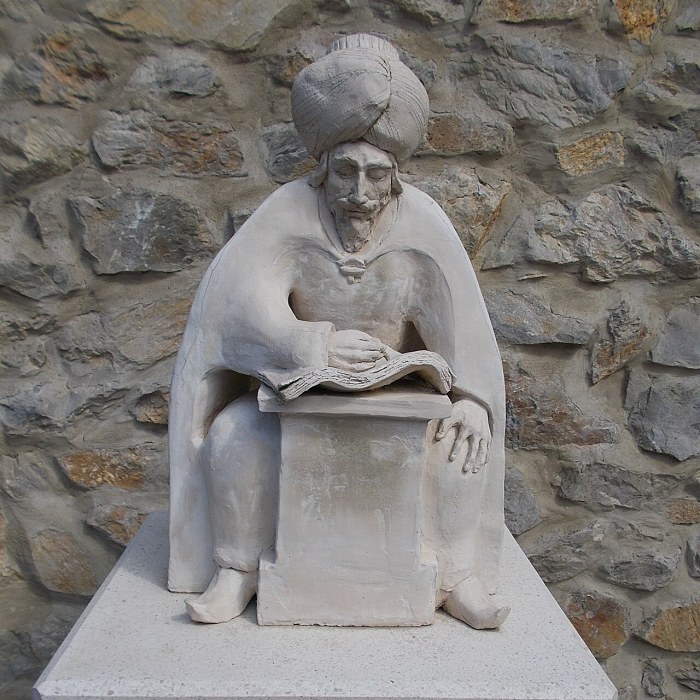
Evliya Çelebi
Spent forty years travelling the Ottoman world and wrote it all down in ten enormous volumes
Evliya Çelebi was born into a comfortable Istanbul family with connections at the Ottoman court, and trained in Quranic recitation and calligraphy before, by his own account, a dream of the Prophet set him on the path of lifelong travel rather than a settled career. Whether taken literally or as a literary device, the dream gave him licence to spend the following four decades almost constantly on the move.
Starting in the 1640s he travelled across virtually the entire Ottoman Empire and its neighbours: Anatolia, the Balkans, the Caucasus, Crimea, Egypt, Arabia and Persia, as well as diplomatic missions as far as Vienna. He usually travelled attached to Ottoman officials, soldiers or diplomatic missions rather than alone, which gave him access to courts and cities that an independent traveller could rarely have reached, from grand viziers' entourages to remote frontier garrisons.
He recorded what he saw in extraordinary and sometimes exhausting detail: the architecture of mosques and bridges, local dialects and songs, food, festivals, superstitions, and no small amount of tall tales and folklore that he seems to have enjoyed passing on as much as verified fact. The result, compiled as the ten-volume Seyahatname, or Book of Travels, is treated by historians as an invaluable, if uneven, record of seventeenth-century Ottoman society, to be checked against other sources rather than taken at face value on every point.
He is believed to have died in Cairo around 1682, having spent most of his adult life refusing to stay anywhere long enough to call it home.