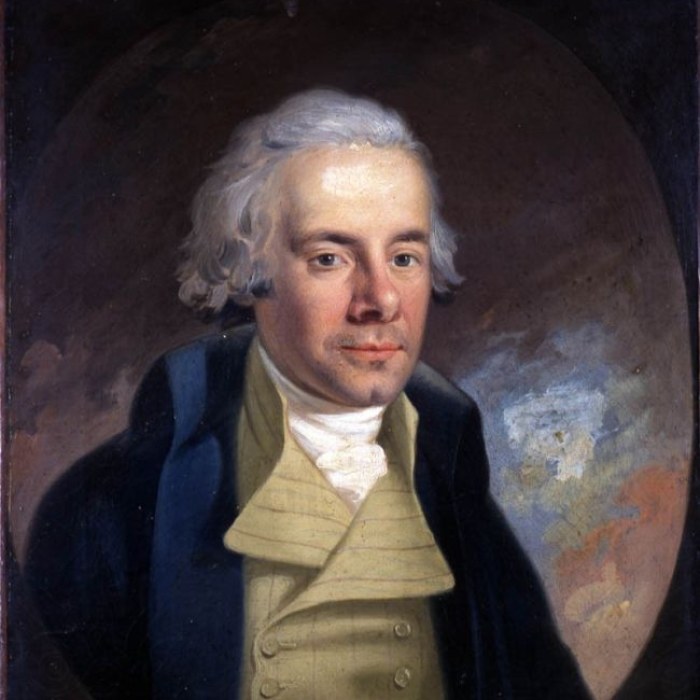
William Wilberforce
Introduced a bill to abolish the slave trade year after year for nearly twenty years until it passed
William Wilberforce was born in Hull in 1759, the son of a wealthy merchant, and was elected its MP at 21 after spending his student years at Cambridge gambling and giving supper parties. He was small and short-sighted, with a speaking voice so fine that James Boswell said he seemed to grow from a shrimp into a whale as he talked. He was a close friend of William Pitt, the future prime minister.
In 1785 he underwent an evangelical conversion and considered leaving politics. Instead, in 1787, Thomas Clarkson and others persuaded him to lead the parliamentary campaign against the slave trade, on which much of Britain's wealth depended. He gave his first great speech against it in 1789 and lost. He introduced an abolition bill in 1791 and lost. He introduced one almost every year after that, through war with France and accusations that he was a dangerous radical, while suffering from ulcerative colitis for which he took opium daily. Slave-ship captains threatened him, and he was challenged to a duel.
The Slave Trade Act passed in 1807, with the House rising to cheer him. He was not radical in other things: he supported laws suppressing trade unions and the radical press, and opponents pointed out that he cared more for enslaved Africans than for English mill workers.
He retired in 1825 in poor health. On 26 July 1833 he was told that the bill to abolish slavery itself in the British colonies would pass. He died three days later.