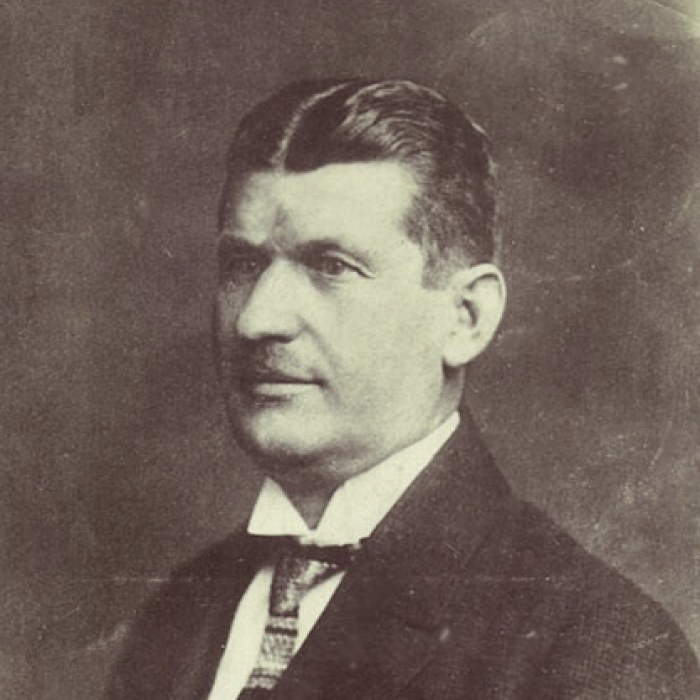
Tomáš Baťa
A cobbler's son who mechanised shoemaking and built an entire town around his factory
Tomáš Baťa was born in 1876 in Zlín, then part of Austria-Hungary and now in the Czech Republic, into a family of shoemakers going back generations. In 1894, with his brother and sister and a very small amount of borrowed capital, he started a shoemaking workshop of his own. The business nearly collapsed within a couple of years when handmade shoes could not compete on price with early factory-made footwear from larger firms.
Rather than give up, Baťa travelled to the United States around 1904 and worked for a period in American shoe factories, studying the mass-production and division-of-labour methods used there. He brought these ideas back to Zlín and rebuilt the company around mechanised, standardised shoe manufacturing, cutting costs enough to sell reliably made shoes at prices ordinary workers could afford, at a time when many people still could not.
The company grew rapidly through the 1910s and 1920s, and Baťa used the profits to build housing, schools, a hospital, cinemas and shops for his workforce in Zlín, turning the town into a model industrial community studied by other manufacturers across Europe. He also introduced profit-sharing schemes and paid close attention to worker welfare, arguing that a healthy, secure workforce made better shoes.
Baťa died in a plane crash near Zlín in 1932 while flying to inspect one of the company's new factories abroad. By then the firm he had rebuilt from near-failure was already selling shoes on several continents, and the Baťa name remains a global footwear brand today.