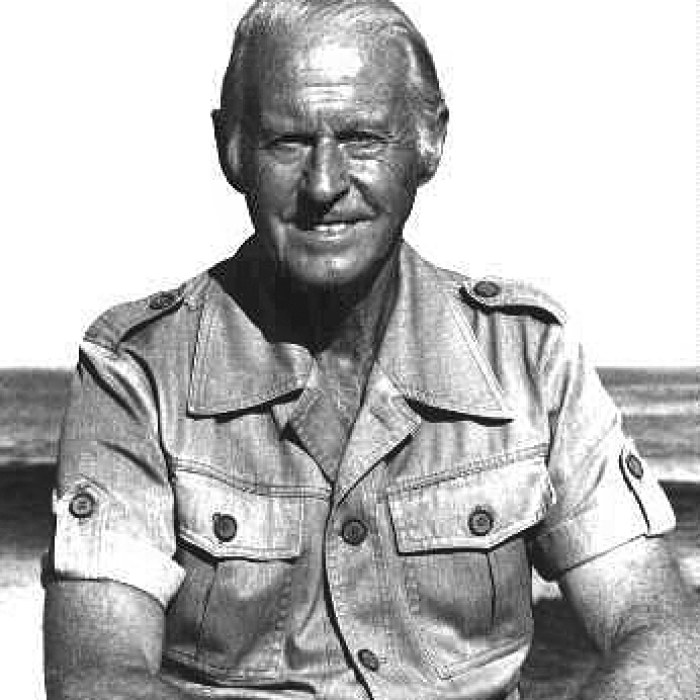
Thor Heyerdahl
Terrified of water as a boy, he crossed the Pacific on a balsa raft to test an idea everyone dismissed
Thor Heyerdahl nearly drowned twice as a child in Larvik and grew up so afraid of water that he did not learn to swim until his twenties. He studied zoology and geography, and in 1937 went with his new wife to live for a year on the remote Marquesan island of Fatu Hiva, where he became convinced that Polynesia had been settled from South America rather than only from Asia. Academics would not read his manuscript.
Rather than keep arguing, he decided to demonstrate that the crossing was possible with the materials ancient people had. In 1947 he and five companions built a raft of nine balsa logs lashed together with hemp rope, with no nails or metal, and set out from Callao in Peru. None of the crew were experienced sailors. For 101 days the Kon-Tiki drifted west with the current and trade winds, the men catching fish, sharks and flying fish, and sleeping in a bamboo hut. The raft was wrecked on a reef at Raroia in the Tuamotus, and everyone survived.
His book sold in the tens of millions and the film won an Academy Award. The theory itself fared less well: linguistic and genetic evidence shows Polynesians came from the west, though recent DNA studies suggest some contact with the Americas did occur.
He went on to sail reed boats from Morocco to Barbados and to excavate on Easter Island and the Maldives. He died in Italy in 2002.