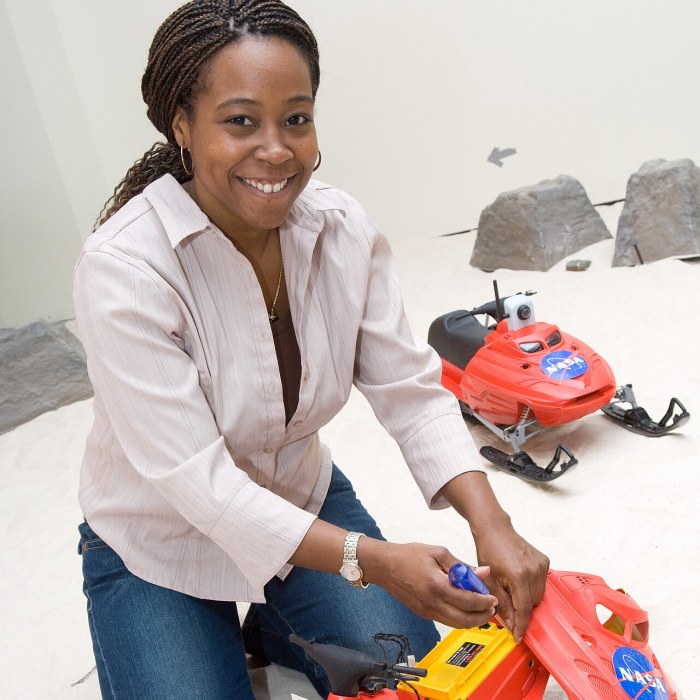
Ayanna Howard
Built robots to help disabled children move and NASA rovers to help scientists see Mars
Ayanna Howard has traced her interest in robotics to watching the television series The Bionic Woman as a child and deciding she wanted to build machines like the ones on screen. She studied engineering and went on to a long career at NASA's Jet Propulsion Laboratory, where she worked on computer vision and navigation systems intended to help Mars rovers assess terrain and hazards on their own, since a rover on the Martian surface cannot wait minutes for instructions from Earth every time it faces an obstacle.
She later moved into academia, becoming a professor of robotics, first at Georgia Tech and later as dean of engineering at Ohio State University, and shifted much of her research toward socially assistive robotics, including robots designed to encourage movement and engagement in children with motor disabilities such as cerebral palsy, work that combined her technical background with an interest in therapy and rehabilitation.
Howard has also become a prominent researcher on bias in artificial intelligence and robotics, studying, among other things, how readily people trust robotic guidance even when it is visibly wrong, and how automated systems can encode and amplify racial and gender bias if built without deliberate attention to it. She co-founded Zyrobotics, a company producing therapy and learning tools for children with special needs, and continues to argue that robotics research is incomplete if it ignores who is, and is not, being designed for.