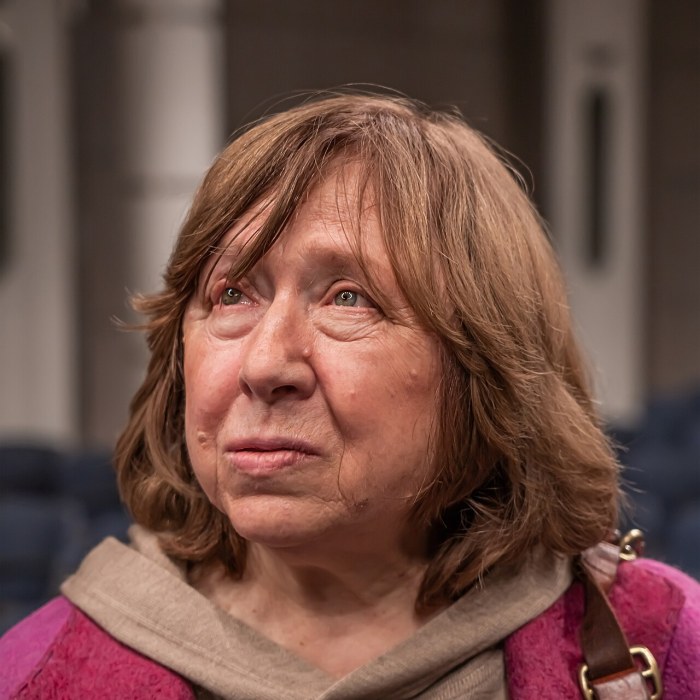
Svetlana Alexievich
Taped thousands of ordinary Soviet voices and turned them into books that dictators tried to bury
Svetlana Alexievich was born in western Ukraine to a Belarusian father and a Ukrainian mother, both village schoolteachers, and grew up in Belarus. She trained as a journalist in Minsk and worked for small regional newspapers, where she discovered that the people she interviewed spoke better about their lives than she could write about them. She began to record them and simply arrange what they said.
Her first book took years. She travelled the Soviet Union with a tape recorder collecting the memories of women who had fought at the front as snipers, pilots, tank drivers and nurses, and who had been told for forty years that the war was a story about men. The Unwomanly Face of War was finished in 1983 and held back by the censors for two years as unpatriotic and naturalistic. It appeared in 1985, in the first breath of glasnost, and sold two million copies.
She did the same for the mothers and widows of soldiers killed in Afghanistan, and was put on trial in Minsk by veterans who said she had defamed them, and for the people who lived through Chernobyl, and for those who had lost everything when the Soviet Union ended. In 2000, under the Lukashenko dictatorship, she left Belarus for a decade in Western Europe.
She won the Nobel Prize in Literature in 2015, the first for a writer of documentary prose, and left Belarus again in 2020 after the crushing of the protests.