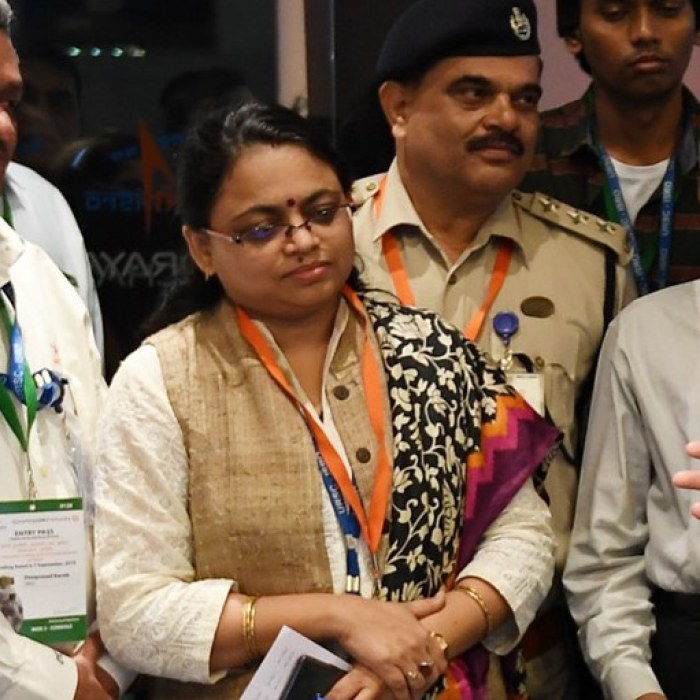
Ritu Karidhal
Directed the operations that put an Indian spacecraft into orbit around Mars on the first attempt
Ritu Karidhal grew up in Lucknow, in a household with no particular connection to science, where she nonetheless kept a scrapbook of newspaper cuttings about the Moon, the planets and India's own fledgling space efforts. She studied physics and went on to aerospace engineering, joining the Indian Space Research Organisation at a time when very few women worked in its technical ranks, and raising two young children while doing some of the most demanding work of her career.
She became deputy operations director for the Mars Orbiter Mission, launched in 2013, which was designed and built on a strikingly small budget and which succeeded in reaching Mars orbit on its very first attempt, a feat only a handful of space agencies in the world had managed even after multiple tries. Karidhal was responsible for the onboard autonomy that let the spacecraft handle emergencies without waiting on instructions from Earth, where a radio signal could take many minutes to arrive.
She went on to serve as mission director for Chandrayaan-2, India's second lunar mission, in 2019, overseeing the complex sequence of manoeuvres needed to place a lander on the Moon's south pole, a landing that ultimately failed in its final moments. The Indian press nicknamed her the Rocket Woman of India, a label she has treated with some discomfort while continuing to work on the country's later missions.