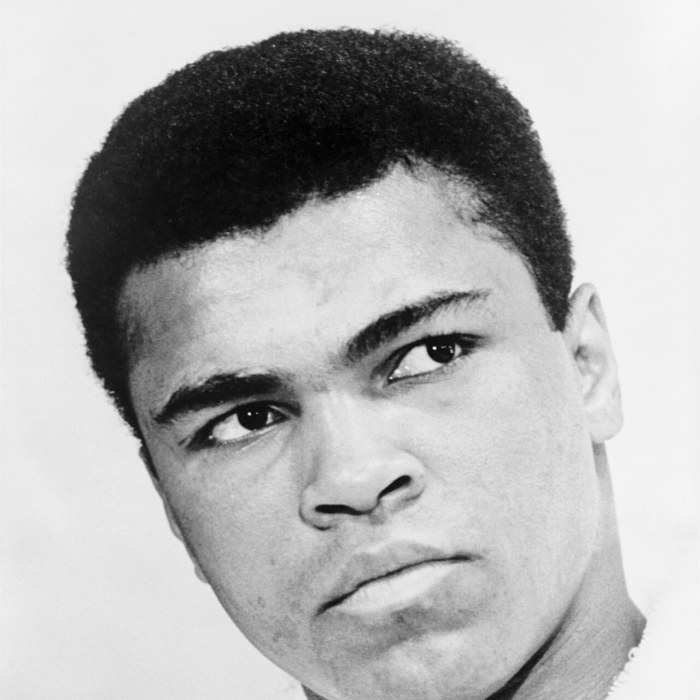
Muhammad Ali
Gave up his title and his best years rather than fight in a war he believed was wrong
Cassius Clay was 12 when his bicycle was stolen in Louisville, Kentucky, and he told a policeman he wanted to beat up the thief. The policeman, Joe Martin, ran a boxing gym and suggested he learn how first. Six years later he won Olympic light heavyweight gold in Rome, and in 1964, at 22, he beat the fearsome Sonny Liston for the world heavyweight title.
Days later he announced that he had joined the Nation of Islam and taken the name Muhammad Ali. Much of the country turned on him. In 1967 he refused induction into the army, saying he had no quarrel with the Vietnamese, and was convicted of draft evasion. Every boxing commission stripped him of his title and licence. He did not fight for three and a half years, from 25 to 28, the years when a boxer is usually at his best, and earned a living speaking on college campuses.
The Supreme Court overturned his conviction in 1971. He lost to Joe Frazier that year, then in 1974 in Zaire, against the far younger and harder-hitting George Foreman, he leaned on the ropes for seven rounds absorbing punishment before knocking Foreman out in the eighth. He regained the title a third time in 1978.
He fought too long, and in 1984 was diagnosed with Parkinson's disease. He did not hide it. Trembling, he lit the Olympic flame in Atlanta in 1996 in front of a watching world, and spent his last decades on humanitarian work.