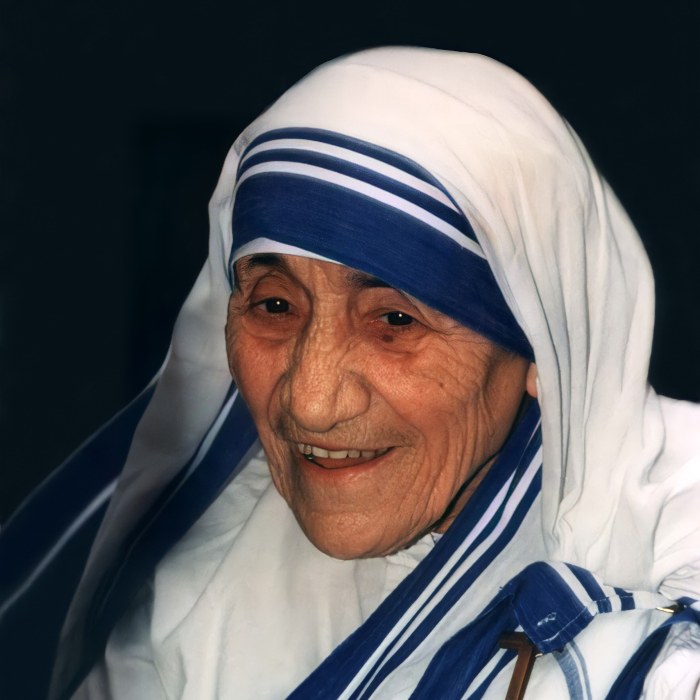
Mother Teresa
Left her convent to live among the dying of Calcutta, doubting God for fifty years
Anjezë Gonxhe Bojaxhiu was born in Skopje to an Albanian family. Her father died when she was eight, and at eighteen she joined the Loreto Sisters in Ireland and was sent to India, where she taught geography at a convent school in Calcutta for nearly twenty years. She was content, and said so.
On a train to Darjeeling in 1946 she experienced what she called a call within a call: to leave the convent and serve the poorest of the poor. It took two years to win permission. In 1948 she swapped her habit for a cheap white sari, took a short medical course in Patna and walked into the slums with five rupees. She began by teaching children to write in the dirt. Former pupils joined her, and in 1950 the Missionaries of Charity were recognised. Two years later she opened Nirmal Hriday, a home where the dying could be taken off the street and cared for.
The order grew to thousands of sisters in over a hundred countries, and she won the Nobel Peace Prize in 1979. Critics, most loudly Christopher Hitchens, charged that her homes offered poor medical care and reused needles, that she opposed contraception in a city of overwhelming poverty, and that she accepted money from dubious donors. Some of that record stands.
Letters published after her death revealed something no one had guessed: for almost fifty years she felt God had abandoned her, and kept working through the silence. She died in 1997 and was declared a saint in 2016.