Mary Prince
The first Black woman to publish an account of her enslavement in Britain, and to petition Parliament
Mary Prince was born into slavery in Bermuda. At about twelve she was sold at auction, separately from her mother and sisters, to an owner she later described as beating his slaves until he was too tired to continue. She was then sent to Grand Turk, where for years she stood up to her knees in brine in the salt ponds from dawn to dark, her legs covered in boils. Later, in Antigua, she was bought by John Wood, joined the Moravian church and taught herself some reading. In 1826 she married a free Black man, Daniel James, and was whipped for it.
In 1828 the Woods took her with them to London. English law would not allow them to force her back to Antigua, but it gave her no way to return there as a free woman. After months of abuse she walked out of the house. She found her way to the Anti-Slavery Society, whose secretary Thomas Pringle employed her as a servant, and in 1829 she petitioned Parliament to be freed so that she could return to her husband. She was the first woman to present an anti-slavery petition.
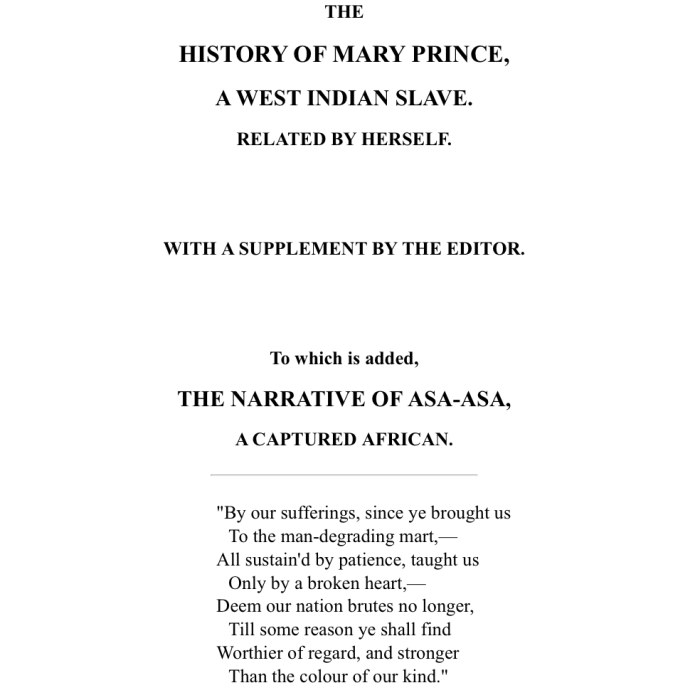
In 1831 she dictated The History of Mary Prince to a young writer, Susanna Strickland. It sold through three editions in its first year and put before the public the detail that pro-slavery writers had denied: the whippings, the sexual coercion, the separation of families. Wood sued for libel, and in 1833 she gave evidence in two trials.
Slavery in the British colonies was abolished that year. After the trials there is no record of what happened to her.