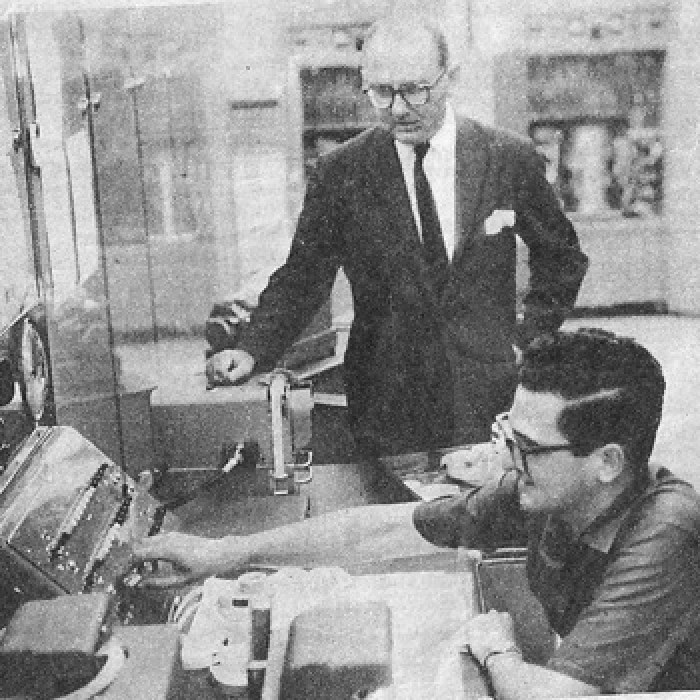
Manuel Sadosky
Brought the first computer to Latin America and built Argentina's computer science from nothing
Manuel Sadosky trained as a mathematician in Buenos Aires and in Paris, and returned to Argentina to teach at a time when the subject barely existed there as a modern research discipline. His academic career was repeatedly interrupted by politics: he was forced out of his university post during the Peron government for his opposition views, and years later was dismissed again, and briefly imprisoned, after the 1966 military coup that purged Argentina's universities of independent-minded scientists in what became known as the Night of the Long Batons.
Between those upheavals, in 1961, he arranged for the University of Buenos Aires to acquire Clementina, an early Ferranti Mercury computer and the first digital computer installed in Latin America, and used it to found the university's Institute of Computing, training the first generation of Argentine programmers and researchers largely from scratch, since no local tradition or textbooks yet existed for the work.
After the 1966 coup he left for Uruguay and later worked internationally, including with UNESCO, before returning to Argentina after the restoration of democracy in the 1980s, when he took on government roles promoting science policy. He is widely credited in Argentina as the founding figure of the country's computer science, and the government's science and technology ministry building bears his name in recognition of the institute he built twice, after having it dismantled by force once.