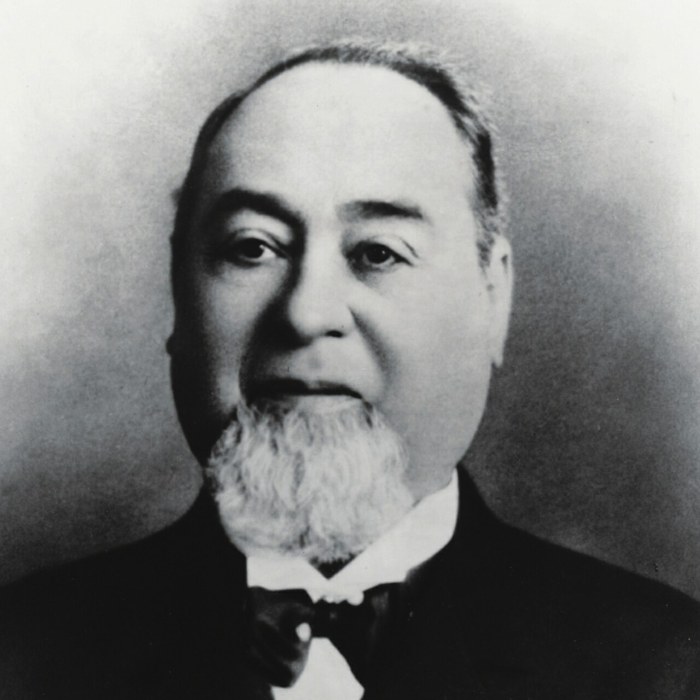
Levi Strauss
A Bavarian immigrant peddler whose tent-cloth trousers became the world's most copied garment
Levi Strauss was born Loeb Strauss in 1829 in the Kingdom of Bavaria. His father died of tuberculosis when he was a teenager, and in 1847 his mother took the family to New York to join two older sons already working there as door-to-door peddlers. Levi learned the trade the hard way, carrying heavy packs of needles, thread and cloth on his back through city streets and rural roads for little return.
In 1853 he moved to San Francisco to open a west coast branch of the family's wholesale dry goods business, supplying general stores and prospectors during the gold rush years with cloth, clothing and other necessities rather than searching for gold himself. The work was steady rather than glamorous, built on long credit terms and careful relationships with small shopkeepers scattered across a rough new territory.
In 1872 a Nevada tailor named Jacob Davis wrote to him with an idea: reinforcing the pocket corners of workmen's trousers with metal rivets so they would not tear under the strain of tools and rock. Davis lacked the money to patent it, so the two men filed jointly in 1873, and Strauss's firm began manufacturing the riveted trousers made from sturdy denim that became known simply as Levi's.
Strauss never married and had no children, and left the firm to his nephews when he died in 1902, still a private, unshowy man. He also gave money quietly to orphanages and to scholarships at the University of California, but it was the trousers, worn by miners, farmers and eventually the whole world, that carried his name forward.