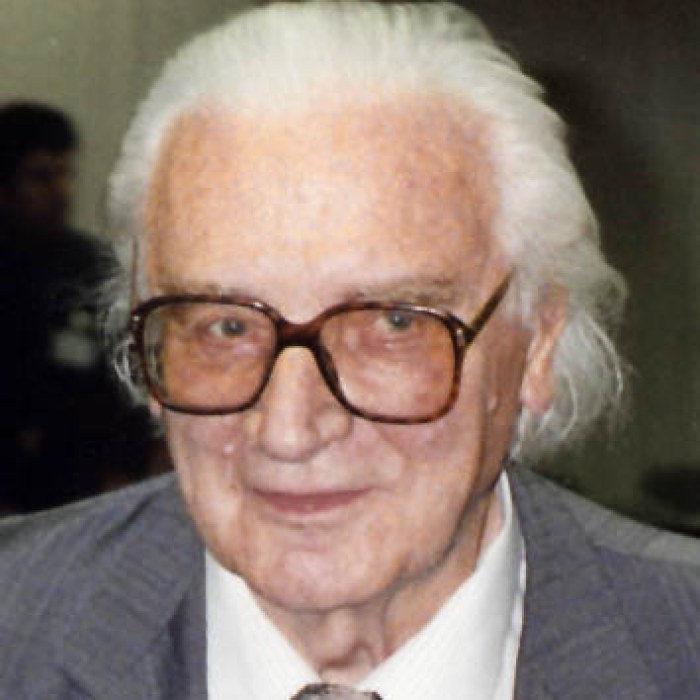
Konrad Zuse
Built the first working programmable computer in his parents' living room
Konrad Zuse trained as a civil engineer in Berlin and took a job at the Henschel aircraft works, where his days were spent doing the same stress calculations over and over. He decided that a machine should do them. In 1936 he quit and set up in his parents' living room, where friends helped him cut thousands of metal plates with a jigsaw.
The result, the Z1, was a mechanical binary computer that was unreliable because the parts jammed. He was drafted at the start of the war, got himself released after six months, and built the Z3 out of about 2,600 second-hand telephone relays. In May 1941 it ran. It read programs from punched film stock, used binary floating-point arithmetic and could be programmed to carry out any calculation. Nobody outside a small circle knew it existed, and the German authorities saw no military use for it. It was destroyed in an air raid in 1943.
Zuse had also worked out, in isolation, a high-level programming language he called Plankalkul, the first of its kind, though it was not published until 1972. His Z4, smuggled out of Berlin as the war ended and hidden in a barn, was leased to the Swiss Federal Institute of Technology in 1950 and for a while was the only working computer in continental Europe.
He founded a computer company, sold it to Siemens in 1967, and spent his last decades painting.