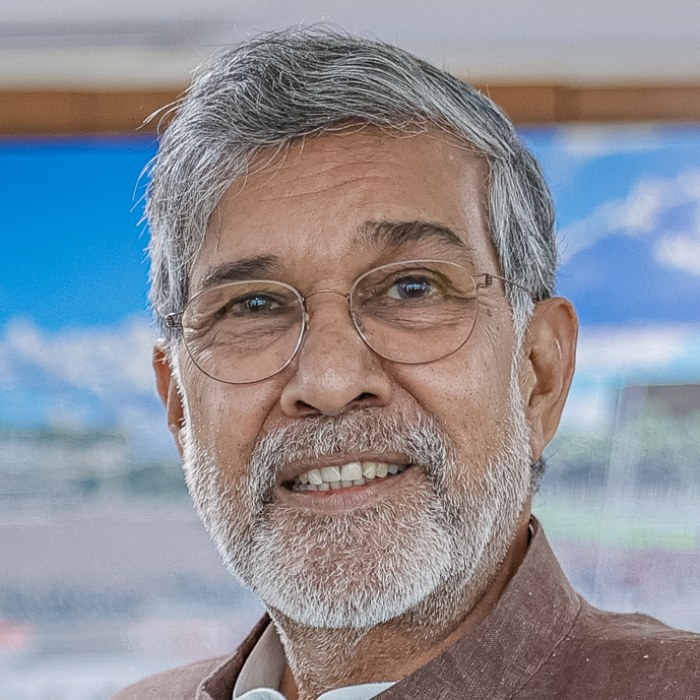
Kailash Satyarthi
Gave up engineering to raid carpet looms and stone quarries and bring enslaved children out
Kailash Sharma was born in Vidisha, in Madhya Pradesh, and remembered as a boy of six watching a cobbler's son his own age who sat outside the school gate mending shoes rather than going in. He trained as an electrical engineer and taught for a few years, but in 1980 he gave up the career to work full time against child labour, and dropped his caste surname for Satyarthi, seeker of truth.
The movement he founded, Bachpan Bachao Andolan, did not begin with policy papers. It began with raids. Tipped off by parents or former workers, Satyarthi and his colleagues went into carpet looms, brick kilns, stone quarries and glass factories, often with a reluctant police escort, and physically walked out with the children they found chained or locked in. Employers fought back. Two of his colleagues were killed, and he has been beaten badly more than once. The group says it has freed tens of thousands of children, and it runs rehabilitation centres to which many of them go, because a rescued child returned to the same debt-ridden family is soon sold again.
He also understood the market. In 1994 he helped launch the Rugmark label to certify carpets made without child labour, so that European buyers could choose. In 1998 he led a Global March Against Child Labour across more than a hundred countries, which helped produce the International Labour Organization convention on the worst forms of child labour the following year.
He shared the 2014 Nobel Peace Prize with Malala Yousafzai. His medal was stolen from his home in 2017 and later recovered.