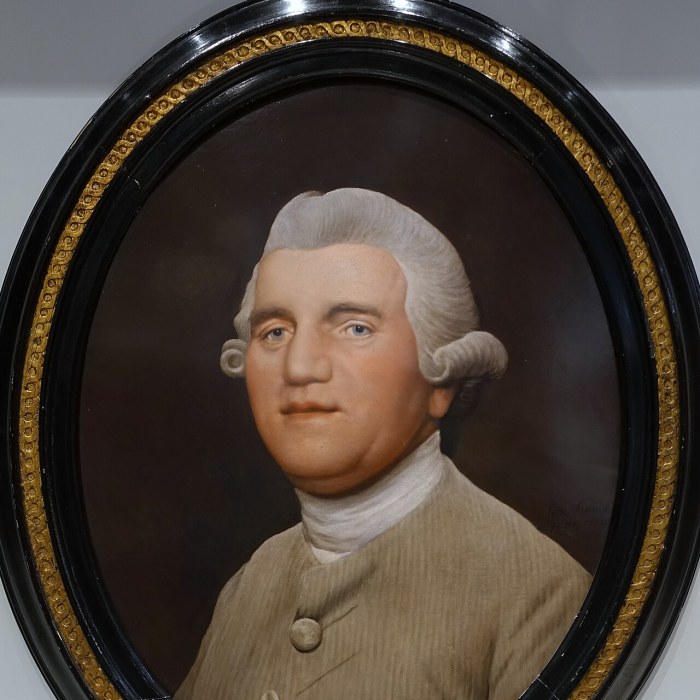
Josiah Wedgwood
A potter who lost a leg, never worked the wheel again, and built an industry instead
Josiah Wedgwood was born in Burslem, Staffordshire, the youngest of thirteen children of a potter who died when the boy was nine. He was apprenticed to his elder brother, but a bout of smallpox at eleven left his right knee permanently damaged. A potter who cannot work the treadle of a wheel cannot throw pots, so he turned to the parts of the trade that did not need two good legs: mixing clays, testing glazes, and keeping careful notebooks of thousands of experiments.
By 1759 he was in business on his own account. A cream-coloured earthenware he perfected caught the eye of Queen Charlotte, who allowed him to call it Queen's Ware, and he used the royal connection shamelessly in his advertising. He opened a London showroom, sent samples to ambassadors, offered money-back guarantees and free delivery, and printed catalogues, most of which were novelties at the time. In 1768 the bad leg was amputated without anaesthetic; he was back at work within weeks.
In 1769 he opened a purpose-built factory called Etruria, with workers' housing alongside it, and divided production into specialised stages years before Adam Smith described the idea. He campaigned for the Trent and Mersey Canal so his fragile wares could travel by water, and was elected a Fellow of the Royal Society for a pyrometer that measured kiln temperatures.
A committed abolitionist, in 1787 he mass-produced a medallion of a kneeling enslaved man with the words "Am I not a man and a brother?", which became the movement's emblem. He died in 1795, leaving a firm that still bears his name and a grandson, Charles Darwin, whose voyage on the Beagle his fortune helped to fund.