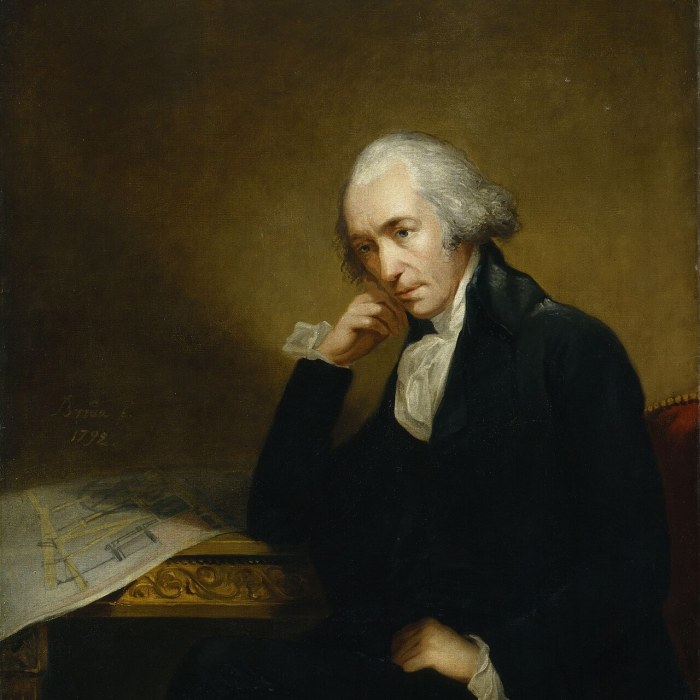
James Watt
Spent a decade making one idea work and set the industrial revolution in motion
James Watt was a frail child in Greenock, taught mostly at home, with such bad headaches that he was thought unlikely to amount to much. His father was a shipwright and merchant, and the boy spent his time in the workshop taking instruments apart. He went to London to train as an instrument maker, but when he came back to Glasgow the guild refused to let him open a shop because he had not served a full apprenticeship. The university gave him a room instead.
In 1763 he was asked to repair a model of a Newcomen steam engine and became fascinated by how wasteful it was, heating and cooling the cylinder on every stroke. Walking on Glasgow Green one Sunday in 1765 he saw the answer: condense the steam in a separate vessel and keep the cylinder hot. The idea took minutes. Making it work took more than a decade.
His first backer went bankrupt. Watt earned his living surveying canals while the engine sat unfinished, and wrote that he could think of nothing else. Only when the Birmingham manufacturer Matthew Boulton took over the partnership in 1775 did the engine become a product, and even then they had to fight to get the patent extended.
The Boulton and Watt engines pumped mines, drove mills and, once Watt added rotary motion, powered the factories of the industrial revolution. He also invented a copying press and coined the term horsepower. The unit of power carries his name.