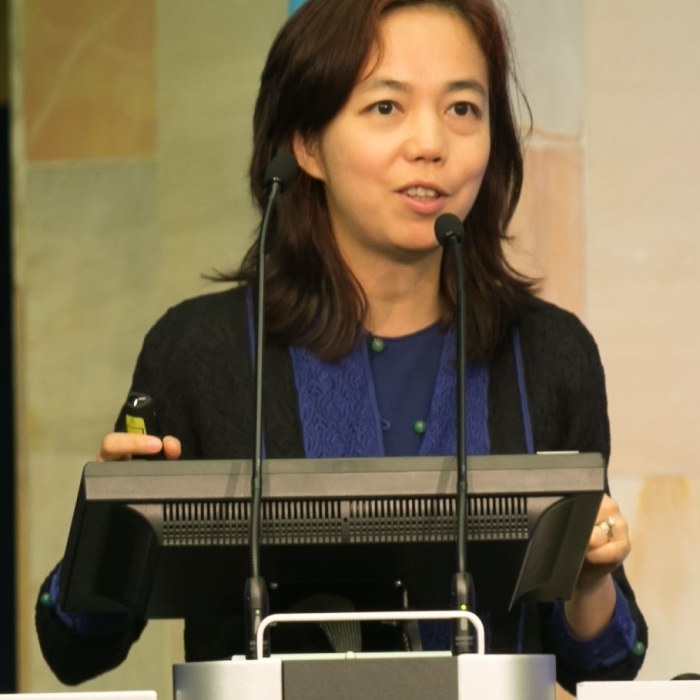
Fei-Fei Li
Built a dataset of millions of labelled images that helped trigger the modern boom in AI
Fei-Fei Li was born in Beijing and moved to Parsippany, New Jersey at fifteen with her parents, who struggled financially in the United States and ran a dry-cleaning shop that she helped keep going while learning English and finishing high school. She went on to study physics at Princeton and then computer science and neuroscience at the California Institute of Technology, drawn to the question of how the human visual system learns to recognise so much from so little instruction.
As a young professor she became convinced that progress in computer vision was being held back not by algorithms but by the lack of enough real, varied, labelled images to learn from. Starting in 2007 she and her collaborators built ImageNet, an openly available database that eventually held more than fourteen million labelled images across thousands of categories, assembled with the help of crowdsourced workers over several years of unglamorous, largely unfunded effort.
An annual competition built around the dataset became the proving ground for a 2012 neural network result that dramatically outperformed older methods, a moment widely credited with helping trigger the current era of deep learning. Li went on to direct Stanford's AI Lab and later its Institute for Human-Centered AI, and has become one of the most consistent public voices arguing that AI development needs more attention to fairness, medicine and human wellbeing, not only raw capability.