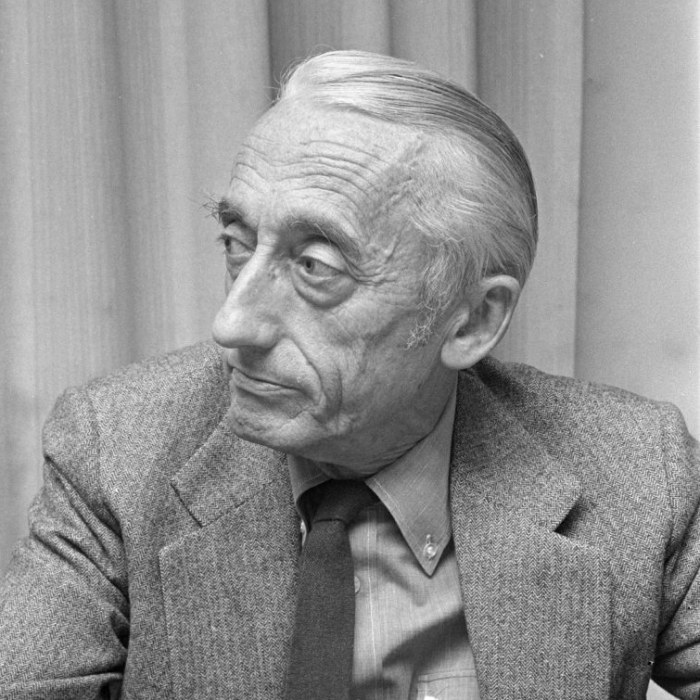
Jacques Cousteau
A car crash ended his flying career, so he went underwater and showed the world what was there
Jacques-Yves Cousteau was a sickly child who was told to avoid exertion and loved swimming anyway. He entered the French naval academy and trained as a pilot, but in 1936 he crashed his father's car on a mountain road at night and broke both arms so badly that one nearly had to be amputated. Flying was over. To rebuild the arms he swam daily in the Mediterranean, and a friend lent him a pair of goggles. He said afterwards that his life changed the moment he put his head under.
During the German occupation, while working for naval intelligence, he and the engineer Émile Gagnan adapted a car regulator valve into a device that fed compressed air to a diver on demand. Patented in 1943 as the Aqua-Lung, it freed divers from air hoses and heavy helmets and made ordinary people's diving possible.
In 1950 a British philanthropist bought him a former minesweeper, the Calypso, and he spent the next four decades sailing it around the world with film cameras. The Silent World won the Palme d'Or and an Academy Award in 1956; his television series ran for years. Early on his crew killed sharks and used dynamite to count fish, things he later regretted openly as he became a campaigner against dumping nuclear waste at sea and for protecting Antarctica.
He lost his son Philippe in a seaplane crash in 1979, and died in Paris in 1997 at 87, still arguing that the sea must be understood before it could be saved.