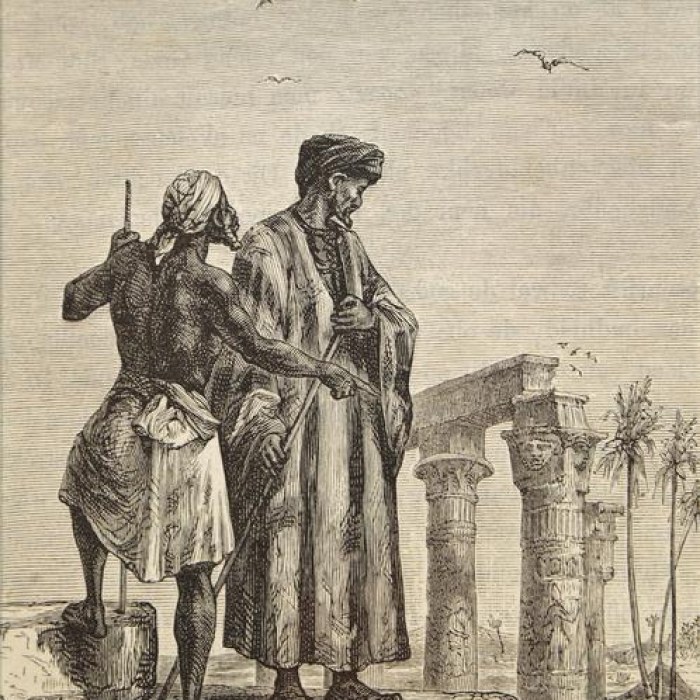
Ibn Battuta
Set out from Tangier for Mecca at 21 and did not stop travelling for nearly thirty years
Ibn Battuta was born into a family of Islamic legal scholars in Tangier and trained in the law himself. In 1325, aged 21, he left for the pilgrimage to Mecca, alone, on a donkey, weeping at the parting from his parents. He would not see his home again for 24 years, and by then both parents were dead.
He was not an explorer in the usual sense. He travelled within the Muslim world, where his training as a qadi, a judge, made him useful and where a learned traveller could expect hospitality from rulers. That world was enormous. From Mecca he went on to Iraq, Persia, East Africa as far as Kilwa, Anatolia, the lands of the Golden Horde on the steppe, Constantinople, and across Afghanistan to India, where the Sultan of Delhi kept him for years as a judge and nearly had him executed. He was sent as an envoy to China, was shipwrecked and robbed on the way, spent time as a judge in the Maldives, married and left several wives along the road, and reached the ports of southern China.
He returned to Morocco in 1349, then travelled again: to Muslim Spain and across the Sahara to Mali, where he was unimpressed by the gifts of the emperor. In 1355 the Sultan of Morocco ordered him to dictate his memories to a scholar, Ibn Juzayy. The result, known as the Rihla, mixes precise observation with borrowed material and boasts, and remains the fullest picture anyone left of the fourteenth-century world.