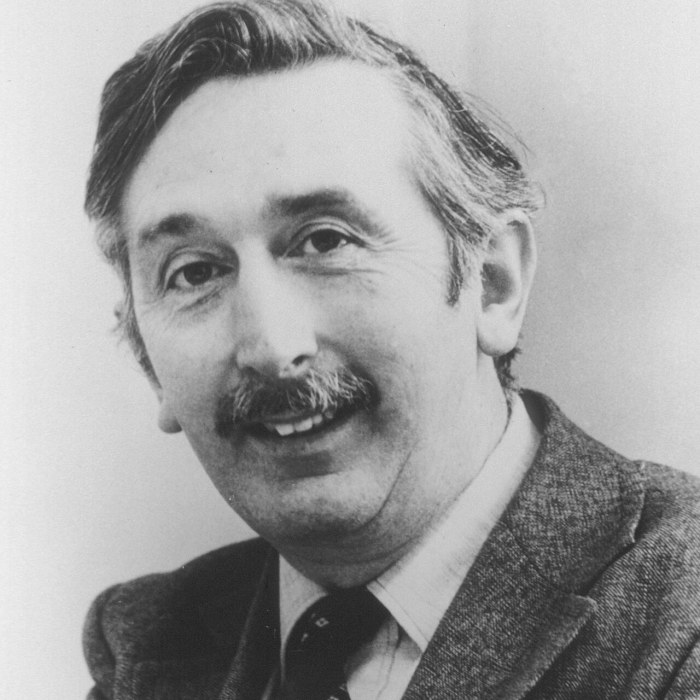
Godfrey Hounsfield
A farm boy with no degree who invented the CT scanner and tested it on a pig's head from the butcher
Godfrey Hounsfield was born in 1919 on a farm at Sutton-on-Trent in Nottinghamshire, the youngest of five. He was not clever at school but spent his time building things: electrical recorders, a glider he launched off haystacks, and a water-jet experiment with tar barrels that nearly killed him. He joined the RAF as a reservist before the war and learned radar. Afterwards a diploma from Faraday House, an electrical engineering college, was the nearest he came to a degree.
He joined EMI in 1949. It was best known for records, but it had a research laboratory, and in the 1950s he led the team that built the first all-transistor computer sold in Britain. In 1967, on a ramble, he began thinking about whether you could work out what was inside a box by taking readings through it from every direction and having a computer reconstruct the contents.
The first apparatus used a lathe bed to move the object and took nine days to scan. He tested it on preserved human brains, then on the head of a pig he fetched across London on the tube from a butcher. The first patient, a woman with a suspected brain tumour, was scanned in October 1971 and the cyst was clearly visible. Doctors had never seen inside a living head like this before.
He shared the Nobel Prize in 1979, was knighted in 1981, never married, and kept working at EMI until his death in 2004.