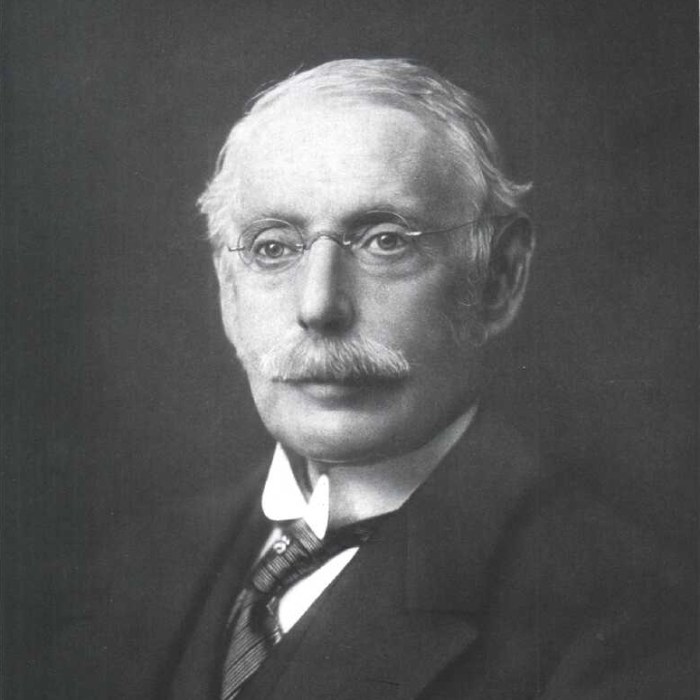
Charles Parsons
Gatecrashed the Royal Navy's review with an uninvited boat to prove his turbine worked
Charles Parsons was the youngest son of the Earl of Rosse, an astronomer who had built the largest telescope in the world in the grounds of Birr Castle in Ireland. The boys were taught at home and had the run of the castle workshops. It was an unusual upbringing for an aristocrat, and after Cambridge Charles did something more unusual still: he paid to become an apprentice at the Armstrong engineering works on Tyneside.
In 1884 he patented a steam turbine, in which steam passed through rows of small blades and spun a shaft directly, instead of pushing pistons. It could run far faster than any reciprocating engine and was ideal for generating electricity. He built the first turbine generators at the firm where he was a junior partner, but when he left to set up his own company in 1889 the patents stayed behind. Rather than give up, he designed a different kind of turbine that worked around his own patent, and later bought the original rights back.
The Admiralty was not interested in turbines for ships. So in 1897, at the naval review for Queen Victoria's Diamond Jubilee, Parsons sent his experimental launch Turbinia racing between the lines of anchored warships at 34 knots. The picket boat sent to stop her could not catch her.
Within ten years turbines drove the battleship Dreadnought and the liners Lusitania and Mauretania. Most of the electricity in the world is still generated by his machine.