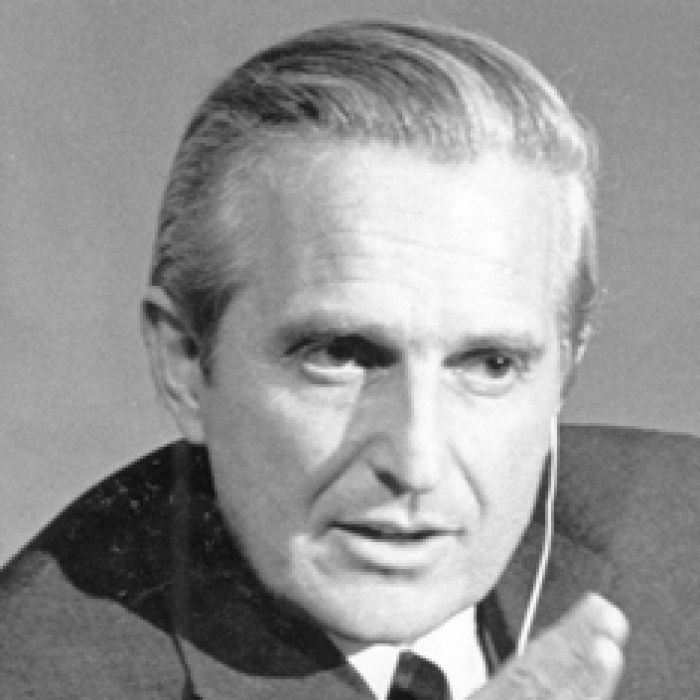
Douglas Engelbart
Demonstrated the mouse, hypertext and video calls in 1968, then lost his funding and was forgotten
Douglas Engelbart grew up on a small farm outside Portland, Oregon, during the Depression. As a Navy radar technician in the Philippines at the end of the war he read an article by Vannevar Bush imagining a machine that could hold all of a person's knowledge and link it together. Back home, engaged and settled, he asked himself what he wanted to do with his life and decided it was to use computers to make people collectively smarter.
In the 1950s this made little sense to anyone. Computers were for calculation, not for people to sit in front of. He took a PhD, joined the Stanford Research Institute and, after years of rejection, got funding for a small lab. In 1963 he and Bill English built the first mouse, a wooden block with two wheels.
On 9 December 1968 he sat on a stage in San Francisco and, for 90 minutes, showed a thousand engineers a system with a mouse, windows, hypertext links, word processing, collaborative editing and a video call to colleagues 30 miles away. It became known as the mother of all demos.
His funding faded in the 1970s and his lab was sold. The mouse patent expired before it earned him anything. Many of his staff went to Xerox PARC and then Apple, where the ideas took root. Recognition came late: the Turing Award in 1997 and the National Medal of Technology in 2000.