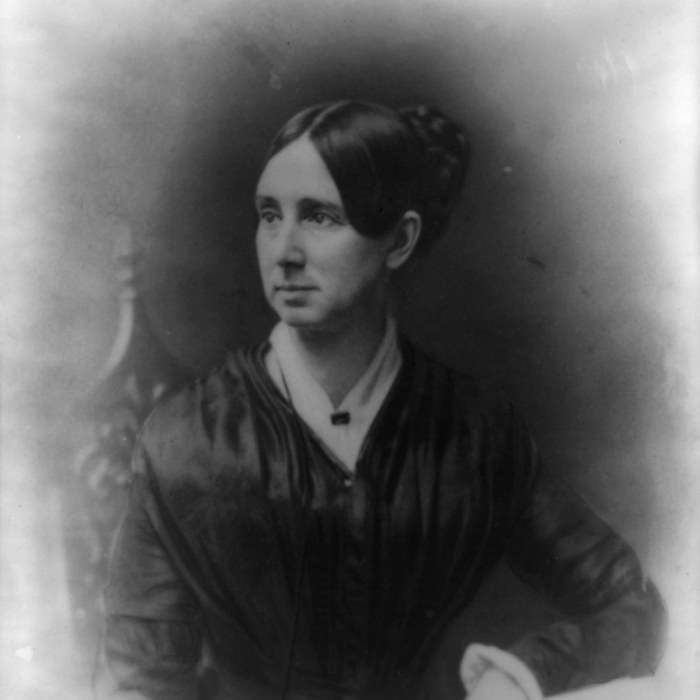
Dorothea Dix
Found the mentally ill chained in unheated cells and shamed legislatures into building hospitals
Dorothea Dix grew up in Maine with an alcoholic, itinerant father and a mother who was often unwell, and was sent to live with her wealthy grandmother in Boston at twelve. She opened a school at fourteen and taught for two decades, writing textbooks on the side, until repeated bouts of lung disease and depression broke her down. Doctors told her she would never work again.
In March 1841, aged 39, she agreed to teach a Sunday school class at the East Cambridge jail. There she found mentally ill women locked in an unheated room, and was told by the jailer that lunatics did not feel the cold. She spent the next eighteen months visiting every jail, almshouse and poorhouse in Massachusetts, filling notebooks with what she saw: people naked, chained, beaten, kept in cages and cellars.
Her report to the state legislature in 1843, delivered by a male ally because women could not address the chamber, caused an outcry and won money to expand the state asylum. She then did the same in state after state, travelling tens of thousands of miles by coach and riverboat, and was directly responsible for the founding or enlargement of more than thirty institutions. A federal bill she had lobbied through Congress for six years was vetoed by President Pierce in 1854.
During the Civil War she served as superintendent of army nurses, a job her rigidity suited badly. She died in 1887 in a room set aside for her in the New Jersey hospital she had founded.