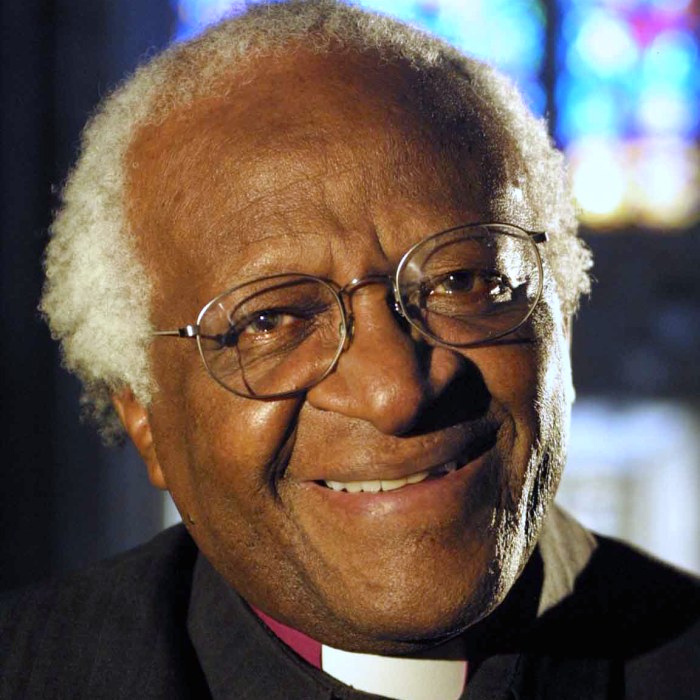
Desmond Tutu
The archbishop who took on apartheid from the pulpit and then chaired the commission that heard its crimes
Desmond Tutu was born in Klerksdorp in 1931, the son of a schoolteacher and a domestic worker, and nearly died of tuberculosis as a teenager. He became a teacher himself, but resigned in 1957 after the government introduced Bantu Education, a deliberately inferior curriculum for Black children. He was ordained an Anglican priest in 1960, studied in London, and rose through a church that was still largely run by white men.
In 1976, weeks before the Soweto uprising, he wrote to the prime minister warning of bloodshed and received a dismissive reply. As general secretary of the South African Council of Churches from 1978 he became the most prominent internal voice against apartheid while the ANC's leaders were in prison or exile, calling for international sanctions, which was itself a crime. His passport was withdrawn. He won the Nobel Peace Prize in 1984 and in 1986 became Archbishop of Cape Town. He waded into crowds to stop the burning of suspected informers, and buried the dead of both sides.
After 1994 he chaired the Truth and Reconciliation Commission, sitting through the testimony of torturers and the bereaved and sometimes weeping openly. He was criticised for offering amnesty in exchange for confession, and he criticised the new government just as freely, calling its later leaders corrupt.
He spoke for gay rights within a reluctant church and for Palestinians and Tibet. He died in Cape Town on 26 December 2021.