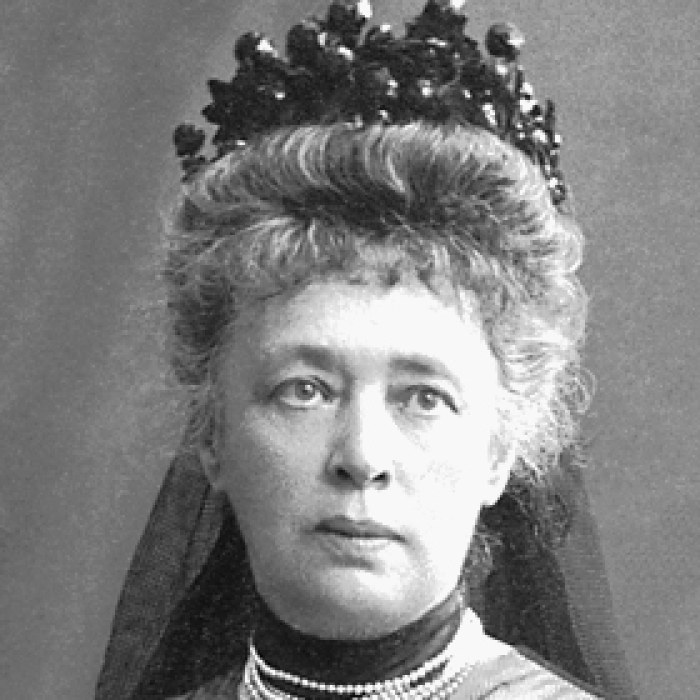
Bertha von Suttner
Wrote the novel that turned Europe against war and persuaded Alfred Nobel to fund a prize for peace
Bertha Kinsky was born in Prague into the Austrian aristocracy, but her father died before her birth and her mother gambled away what money there was. At thirty she took a job as governess to the daughters of the von Suttner family in Vienna, and fell in love with their son Arthur, seven years younger. His parents found out and sent her away. She answered an advertisement placed by Alfred Nobel for a secretary in Paris, worked for him for barely a week, and then went back to Vienna and married Arthur in secret.
The couple fled to Georgia, in the Caucasus, and lived there for nine years in something close to poverty, giving lessons and writing anything that would sell. She had no particular interest in peace until, back in Europe in the 1880s, she read about the new international arbitration societies and decided to write a novel about war from the point of view of a woman who loses her husbands to it. Lay Down Your Arms, published in 1889 after several publishers turned it down, went through dozens of editions and was translated into most European languages.
From then on she organised. She founded the Austrian Peace Society in 1891, edited a journal, addressed congresses across Europe and the United States, and kept up a long correspondence with Nobel, urging him to give money to the cause. His will, when it was read in 1897, included a prize for peace. She won it in 1905, the first woman to do so.
Arthur died in 1902. She kept lecturing, warning of the arms race and of aviation as a weapon, and died in June 1914, seven days before the assassination that began the war she had predicted.