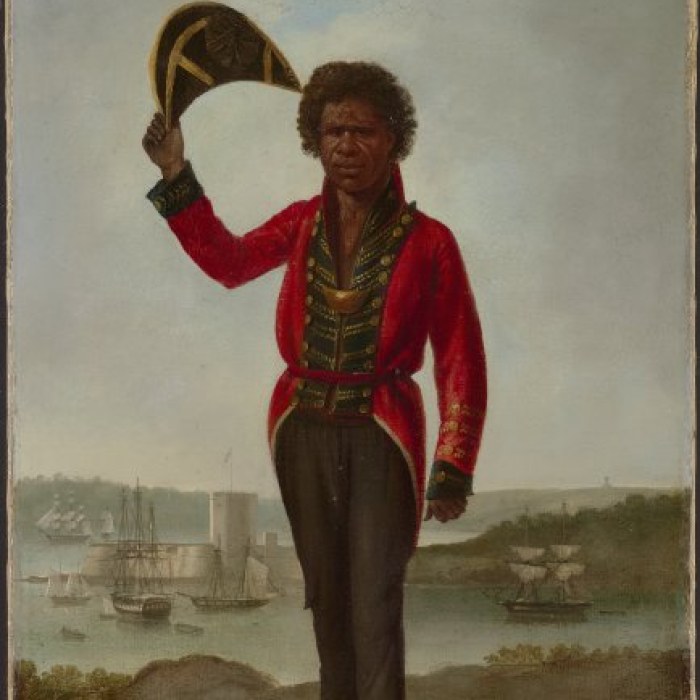
Bungaree
The Aboriginal navigator and diplomat who sailed right around Australia before it had that name
Bungaree was a senior man of the Kuringgai people from the Broken Bay region north of Sydney, already known to the small British colony for his wit and his skill at moving between two very different worlds. In 1799 the navigator Matthew Flinders took him on a voyage north along the coast, and found his presence eased tense meetings with Aboriginal groups who had never encountered the British before.
That experience led Flinders to invite him aboard HMS Investigator for the full circumnavigation of Australia in 1801 to 1803, the voyage that gave the continent its modern name. Bungaree acted as an intermediary again and again, going ashore first to signal peaceful intent, interpreting gestures and customs neither side understood, and defusing standoffs that might otherwise have turned violent. He became, by most accounts, the first Aboriginal person known to have circumnavigated the continent.
He sailed on further coastal survey voyages afterwards, including with Phillip Parker King a decade later, and became a familiar figure in Sydney, known for his mimicry of the colony's governors and for adopting, half in jest and half seriously, the title "King of the Aborigines." Governor Macquarie granted him land at Georges Head and gave him a boat to farm and fish, part of an early and largely unsuccessful colonial attempt to settle Aboriginal families onto smallholdings.
The farm failed as government support dwindled and the surrounding land was taken for other uses. Bungaree spent his later years moving between Sydney and the harbour settlements, respected by sailors who had served with him, increasingly marginalised by the colony he had helped chart. He died in 1830.