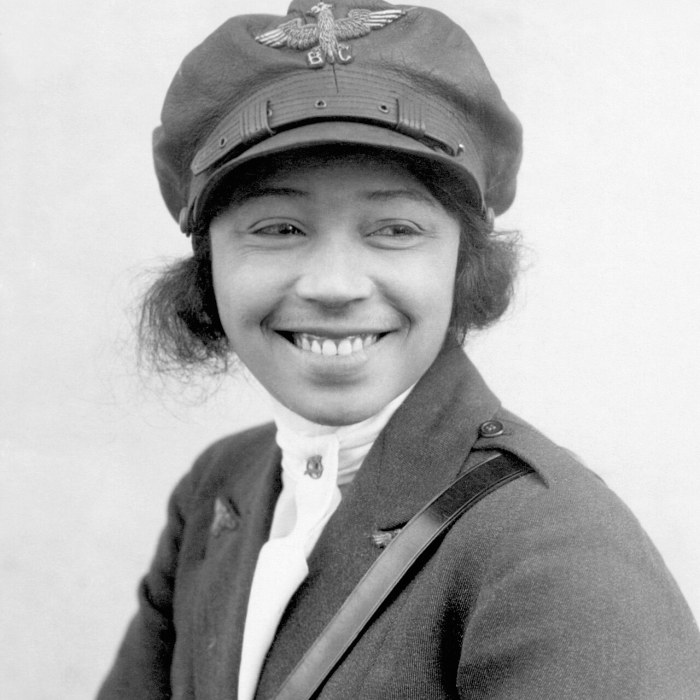
Bessie Coleman
Refused by every flying school in America, she learned French and went to France to earn her licence
Bessie Coleman was born in Texas, one of thirteen children of a mother who was Black and a father of Cherokee and African American descent who left the family when she was small. She picked cotton, walked four miles to a one-room school, and managed one term at a college in Oklahoma before the money ran out. At 23 she moved to Chicago and worked as a manicurist in a barber's shop, where she heard the stories of pilots returning from the war in France.
No flying school in the United States would take a Black woman. With encouragement from Robert Abbott, publisher of the Chicago Defender, she took French lessons at night, saved, and in 1920 sailed to France. She trained at the Caudron school at Le Crotoy, and in June 1921 the Fédération Aéronautique Internationale granted her a licence, the first ever held by a Black woman or by a woman of Native American descent.
Back home, commercial flying was closed to her, so she made her living as a barnstormer: loops, figure eights and parachute jumps at air shows across the country. She spoke in churches, schools and theatres to encourage Black Americans to fly, and refused to appear anywhere that the audience was made to enter by separate gates. In 1923 she broke a leg and three ribs in a crash and was flying again within months.
She was saving to open a flying school when, on 30 April 1926, a wrench jammed the controls of her plane during a practice flight in Jacksonville and she was thrown from the open cockpit. Ten thousand people attended her funeral in Chicago.