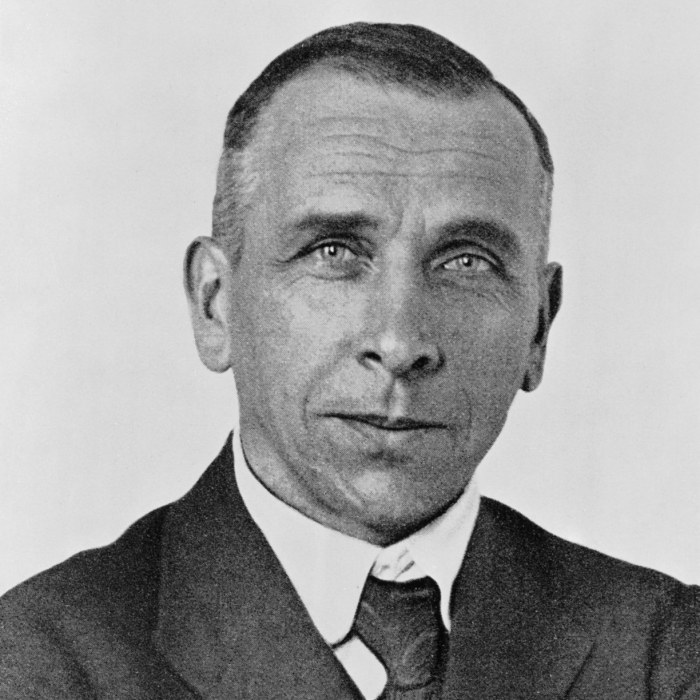
Alfred Wegener
Said the continents move, was laughed at for it, and died on the Greenland ice
Alfred Wegener was born in Berlin in 1880 and took a doctorate in astronomy, but the sky he wanted was closer to hand. He became a meteorologist, and in 1906 he and his brother set a world record by staying aloft in a balloon for 52 hours. That year he joined a Danish expedition to Greenland, the first of four. On the second, in 1912, he and a companion crossed the ice cap on foot and nearly died of starvation before reaching the far coast.
Around 1910 he noticed how well the coasts of South America and Africa fitted together, and began collecting evidence: matching rock formations and fossils on opposite sides of the Atlantic, and traces of glaciers in places now tropical. In 1912 he proposed that the continents had once been joined and had drifted apart. His book on it was published in 1915 while he was recovering from wounds sustained in the war.
The reaction was hostile. He could not explain what force could move continents, and geologists, particularly in America, dismissed him as an outsider, a weatherman trespassing on their field. He could not get a professorship in Germany and took one in Austria in 1924.
In 1930 he led an expedition to establish a station in the middle of the Greenland ice cap. Supplies ran short, and in November, on his fiftieth birthday, he set out with a Greenlandic companion, Rasmus Villumsen, to return to the coast. His body was found the following spring, carefully buried in the snow. Villumsen was never found. In the 1960s measurements of the sea floor showed that the continents move after all.