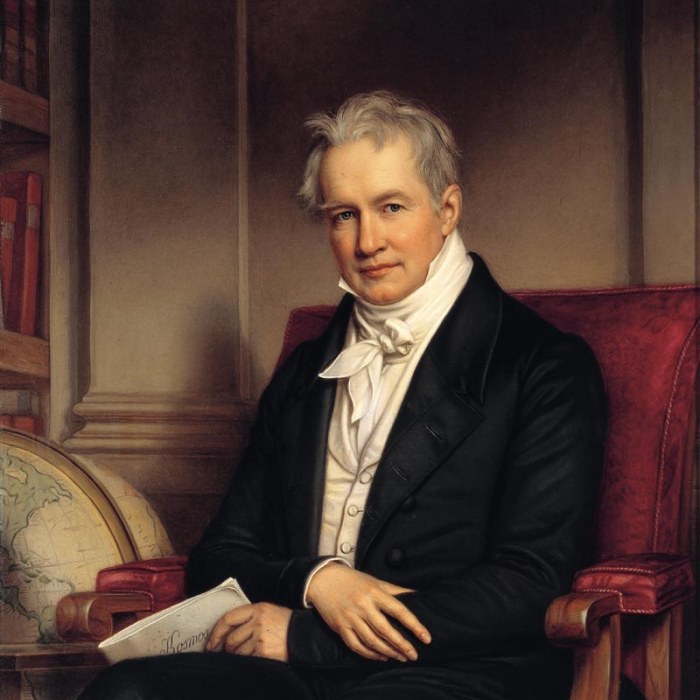
Alexander von Humboldt
Climbed a volcano further than anyone had gone and came back seeing nature as one connected system
Alexander von Humboldt trained in mining and geology but was drawn to the natural sciences broadly, and in 1799, using his own inheritance, set off with the botanist Aimé Bonpland on a self-funded expedition to Spanish America that would last five years. Spanish authorities rarely allowed foreign scientists such access, but Humboldt's connections and persistence secured a rare royal permit.
He and Bonpland travelled through Venezuela, along the Orinoco River, through Cuba, and across the Andes into Ecuador, Peru and Mexico, carrying an extraordinary quantity of scientific instruments for the time. In 1802 they attempted to climb Chimborazo, then believed the highest mountain in the world; altitude sickness and a crevasse-riddled ridge stopped them short of the summit, but they reached roughly 5,900 metres, further than any recorded ascent before them, gasping blood from their gums in the thin air.
Humboldt measured everything he could: temperature, magnetism, altitude, the ocean current off South America's Pacific coast that would later carry his name, and the distribution of plants at different elevations, which he sketched as a single cross-section of Chimborazo showing vegetation zones changing with height. It was an early and influential way of showing nature as an interconnected system rather than a catalogue of unrelated specimens.
He returned to Europe in 1804 and spent decades publishing his findings, work that directly influenced Charles Darwin, who carried Humboldt's writing on his own voyage. In old age Humboldt made a second major expedition, across Russia and Siberia in 1829, and continued publishing until shortly before his death in Berlin in 1859, by then one of the most famous scientists in the world.